
BUYING GUIDE
How Many Grams of Hair Extensions Do I Need? A Salon Planning Guide
Work out tape-in tabs, pairs, clip-in set weights and weft quantities. Compare DR formats before planning a salon order.
Introduction
Start with the extension method and the result you want, then confirm the fitted amount with a stylist. For standard DR Tape-in Hair, 100g means 40 individual tabs, or 20 paired attachments when two extension tabs are used at each position. A 150g quantity at that same specification would mean 60 tabs and 30 pairs. These are product conversions, not a full-head prescription for every client.
Clip-ins need a different comparison. DR's regular Clip-in Hair offers 100g, 120g, 160g and 180g set options, with a customized piece layout. The right choice depends on coverage, length, natural-hair condition and how the pieces fit, as well as total grams.
This guide explains the calculations, common counting mistakes and questions that make a quantity recommendation useful. DR Hair Extension publishes it as a manufacturer and wholesale supplier using our current catalog. The worked examples are planning illustrations; they are not reports of completed client installations.
Understand grams, pieces, pairs, rows and packs
These units answer different questions. A quotation that says only “two packs” or “40 pieces” leaves the actual quantity unclear.
| Unit | What it describes | What it does not establish |
|---|---|---|
| Grams | The stated weight for the selected hair product | Suitable fitted weight for an individual |
| Individual tape tab | One supplied adhesive-backed piece | One complete two-tab attachment |
| Tape pair or sandwich | Two extension tabs used around a natural-hair section | A whole row or full-head service |
| Clip-in piece | One panel carrying one or more clips | One clip, or an equal share of set weight |
| Weft | A supplied length of hair attached along a seam | One installed row |
| Pack or set | The supplier's defined sales unit | A standard quantity shared by all brands |
Confirm what the quoted weight includes. Hair quantity, finished attachment weight and shipping weight are different measurements. For a custom order, agree the weighing basis with the supplier, especially when comparing clip-in sets with different bases or clip layouts.
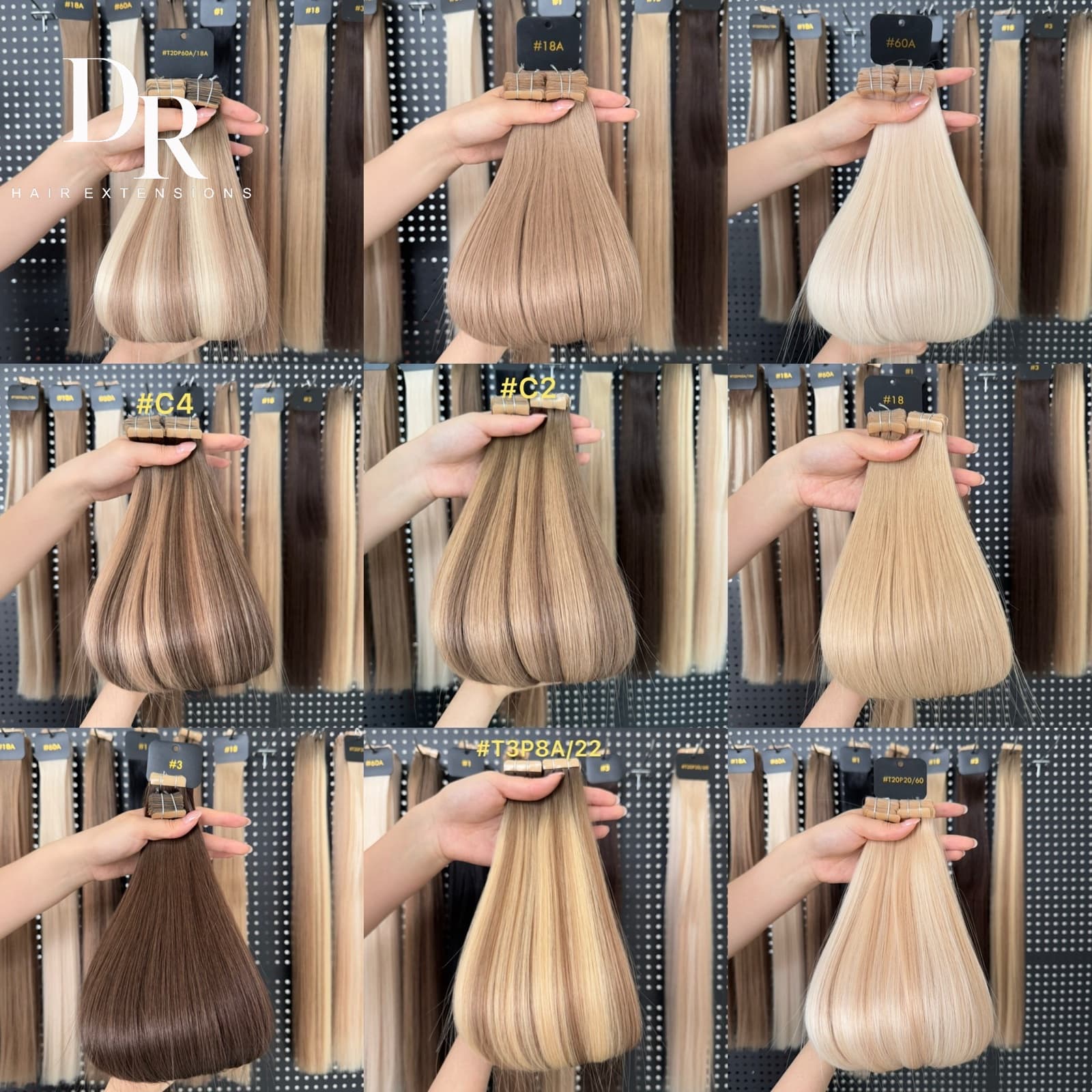
A collection photograph shows the product format and colors. It cannot verify how much a client should wear or whether every photographed bundle belongs to one saleable pack.
What determines how many grams you need?
Volume, length and the existing haircut
Adding fullness near the existing length is a different task from extending a short, blunt haircut substantially. The latter needs a blend through the transition where the natural hair ends. Adding more grams without reviewing the haircut may still leave an obvious step.
Bring a current back-view photograph and a realistic reference for the desired result. State whether the priority is fuller ends, additional length, temporary styling or a combination. A remote photograph can help prepare a consultation, but it does not replace checking the hair and scalp in person.
Density, strand fineness and coverage
Fine individual hairs and low overall density are separate characteristics. The stylist needs to assess both, alongside the condition of the proposed attachment areas and the natural hair available to cover them.
A high gram count is not automatically a better result. The installation must fit the available areas without relying on weak hair to carry extra weight. If the desired look requires more than the stylist considers appropriate, adjust the length, fullness or method.
Length, texture and end distribution
Compare quantities at the same length and texture. A longer product distributes its hair weight over more length; a curled product and a straight product also present differently. End fullness matters alongside the number on the label.
Ask to see the selected sample through its full length, rather than comparing only the top bundle. Our single drawn vs double drawn guide explains why weight alone cannot describe end distribution. For method selection, use the separate fine or thin hair guide.
How many tape-in extensions for a full head?
There is no standard full-head tab count across every product and client. As a named reference, Superior Hair's quantity guide lists 40–60 individual pieces for a full head of its Invisi tape skin weft: four to six 25g, 10-piece packs. That is 100–150g for that range, with the final recommendation adjusted by a stylist.
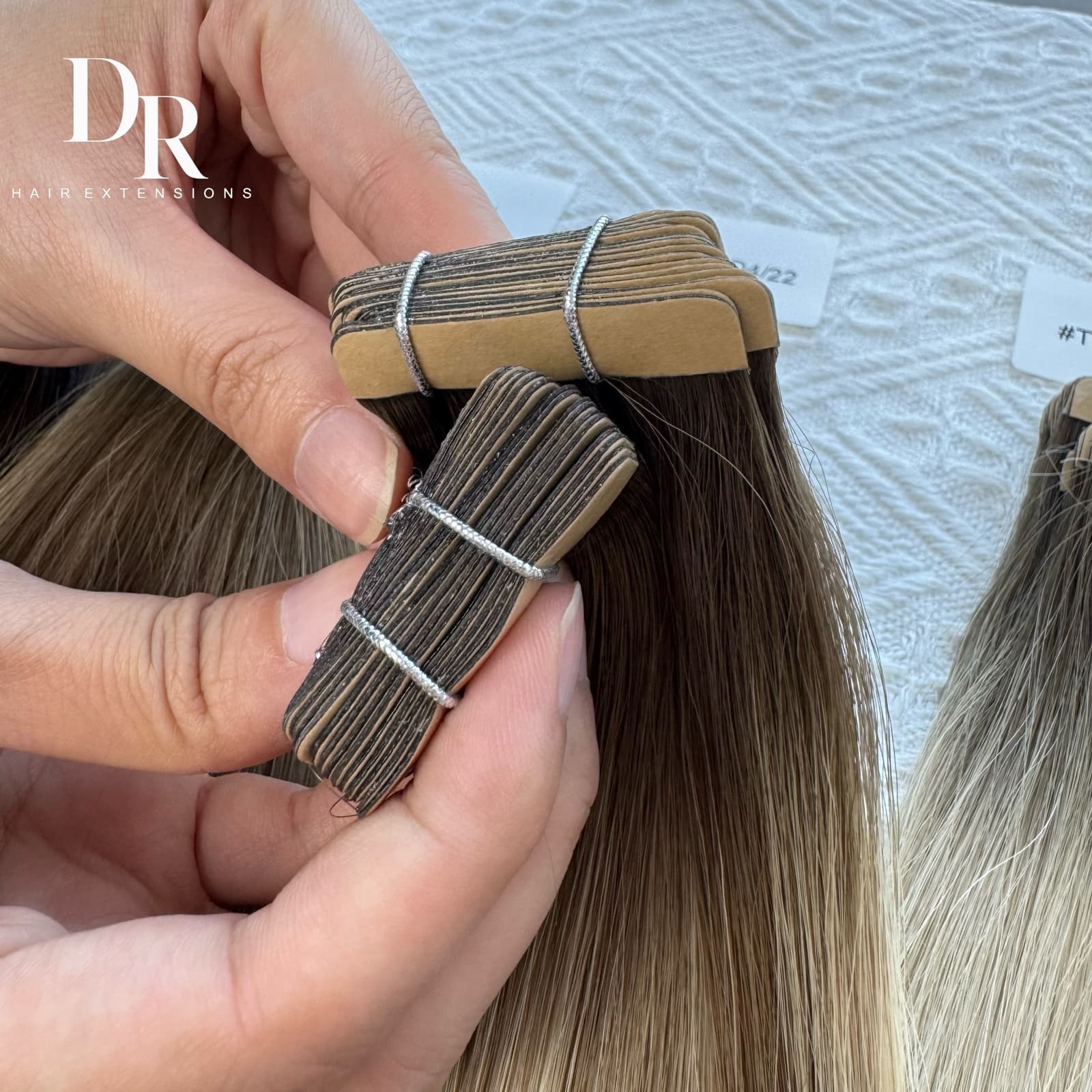
DR's regular Tape-in Hair uses a different pack size: 100g containing 40 individual tabs. Each standard tab has a 4 × 0.8cm attachment and averages approximately 2.5g. Use that specification when converting a professional recommendation into a DR order.
Convert individual tabs into paired attachments
The table assumes two extension tabs per attachment. It is arithmetic for the standard DR format, not recommended fitted quantities.
| Hair quantity at the standard ratio | Individual tabs | Two-tab pairs | Average hair per pair |
|---|---|---|---|
| 50g | 20 | 10 | Approximately 5g |
| 100g | 40 | 20 | Approximately 5g |
| 150g | 60 | 30 | Approximately 5g |
| 200g | 80 | 40 | Approximately 5g |
The 50g and 150g rows are quantity conversions, not promises of standard retail pack sizes. DR's regular Tape-in minimum order is 100g per color and length; confirm any custom pack weight and piece count with the quotation.
“Forty sandwiches” would mean 80 individual extension tabs, approximately 200g at this ratio. “Forty pieces” means 40 tabs only when the seller defines a piece as one individual tab. Ask that question before comparing prices.
For a different fitting system, including an approved single-sided arrangement, have the stylist specify which pieces are hair-bearing and how the required quantity is counted. Do not automatically apply the two-tab formula.
Turn the stylist's tape plan into an order
Suppose a stylist has assessed a client and specified 28 paired positions using the standard two-tab arrangement. The calculation is:
- 28 pairs × 2 tabs = 56 individual tabs.
- 56 tabs × approximately 2.5g = approximately 140g of extension hair.
That example begins with a professional placement plan. It does not mean 28 pairs are appropriate for every client. If hair is supplied only in standard 100g packs, two packs provide 80 tabs in total. The remaining 24 tabs are inventory, not an instruction to install extra hair.
Record which shades are needed at each position. Buying enough total grams can still leave a shortage of one color. MOQ per shade and length, pack configuration and any spare material should be confirmed before ordering.
DR Invisible Tape Hair also has a standard 100g / 40-tab format, but it has separate made-to-order terms. Current minimums are 200g for solid or piano colors and 300g for rooted or balayage colors. Confirm the selected order configuration. Those purchasing minimums do not determine the amount to install on one client.
How many grams of clip-in extensions do I need?
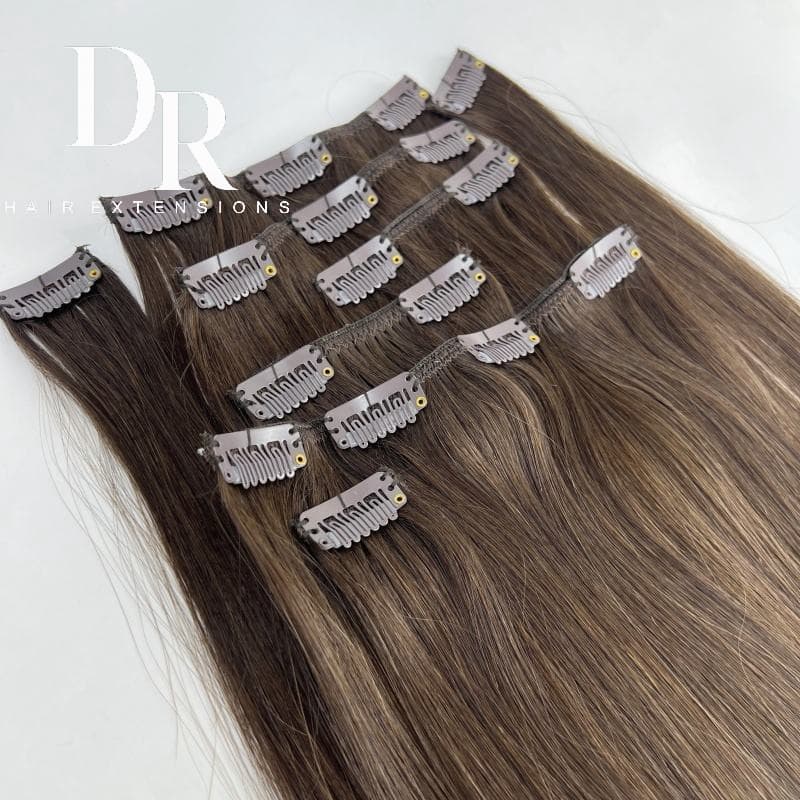
Choose a complete set specification rather than transferring a tape-in count to clip-ins. DR Clip-in Hair lists 14–26-inch lengths and 100g, 120g, 160g or 180g sets. Piece counts are customized to customer requirements. Our PU Clip-in Hair uses a PU base with metal clips and lists 100–180g options, also with a custom layout.
| DR regular Clip-in option | What to compare before choosing |
|---|---|
| 100g | Coverage, desired fullness and whether the selected panels blend at the chosen length |
| 120g | The additional hair and its distribution across the specified pieces |
| 160g | Panel widths, clip positions, coverage and comfort at the selected length |
| 180g | Whether the fuller specification fits the wearer and intended temporary style |
These are available set options, not hair-type prescriptions. Bombay Hair's clip-in selection guidance likewise considers natural-hair thickness and desired fullness, with overlapping weight choices across categories. Its gram ranges belong to its collection and are not DR sizing rules.
Count panels separately from clips
A panel carrying three clips is one piece, not three extension pieces. Two sets with the same total grams can have different panel widths, clip counts and weight distribution. A set with more pieces may simply divide the same hair into smaller sections.
Ask for a layout showing each panel's width, clip positions and, where needed, weight. Do not divide the total set weight equally by the piece count unless the supplier confirms equal-weight panels. Wider back pieces and narrow side pieces may contain different amounts of hair.
Approve a fitting and blending plan for the intended style. Buying a second set or stacking pieces to chase more grams may create unnecessary bulk. Our clip-in selection guide covers base construction and coverage in more detail.
How do weft grams relate to pieces and rows?
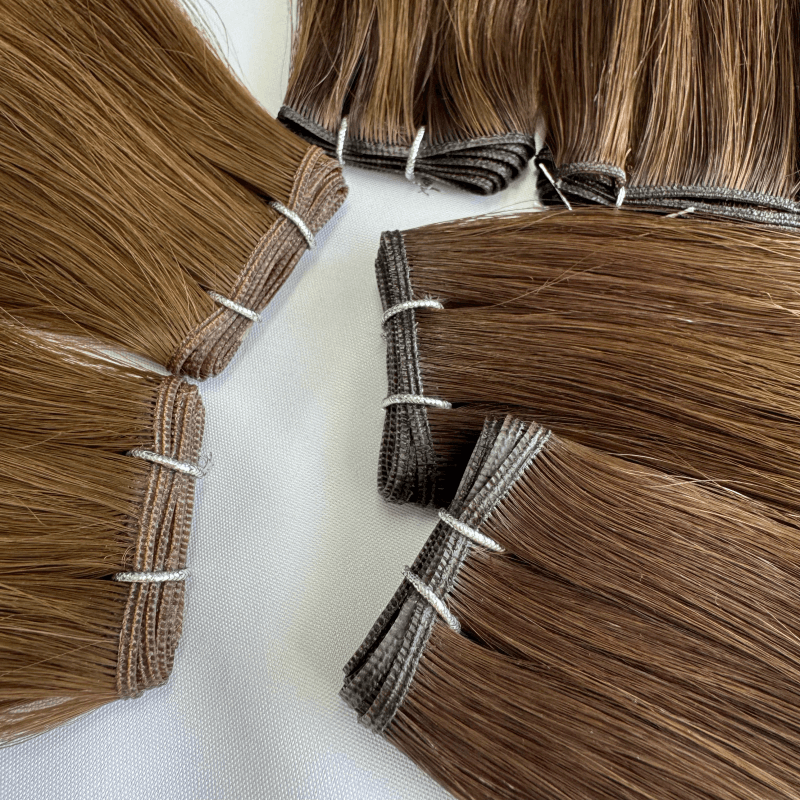
DR Genius Weft has a standard 100g pack that can be divided into two, four or five supplied wefts. The corresponding averages are 50g, 25g or 20g per weft. A five-piece 100g pack does not contain more hair than a two-piece 100g pack.
For the standard two-piece configuration, each supplied weft is approximately 80cm wide. Confirm widths for other configurations rather than assigning every piece that same dimension. A stylist plans how supplied material becomes suitable rows; a pack piece and an installed row are different units.
Length along the seam also differs from hanging hair length. Record both when comparing products. Cutting, row design, blending and unused material affect how much of a purchase is fitted. The correct number of rows cannot be calculated from pack grams alone.
Check the quantity before product application
During installation preparation, separate the order into quantities received, reserved and intended for fitting. Keep unused pieces identified by shade, length and product reference. The installed count should follow the agreed plan rather than the desire to empty a pack.
The American Academy of Dermatology recommends professional fitting and warns that pain or headaches can indicate an overly tight style. Repeated pulling can cause traction hair loss. Promptly raise discomfort with the stylist; consult a dermatologist for scalp or hair-loss concerns.
Factory testing and shipment inspection answer a different question: whether supplied goods match the agreed specification. DR's confirmed QC process includes weighing every pack, production-stage checks and final sampling for weight, measured length, color, shedding and smoothness. A sampled nonconformity triggers full reinspection of the affected shipment. These checks do not determine an individual's appropriate fitted quantity.
For your sample review, reconcile the label, actual piece count and agreed weighing basis. Record any discrepancy before fitting. Request additional checks or tolerances explicitly rather than assuming an unpublished acceptance standard.
Make the quote match customer requirements
A useful inquiry states the method, hair option, shade, length, total grams, piece count, attachment dimensions or panel layout, number of packs or sets and destination. Also distinguish salon stock from a single client's service quantity.
Ask the supplier to itemize hair, delivery and any custom packaging. Compare the salon's fitting, blending, removal and maintenance charges separately. Cost per gram can help compare otherwise identical hair specifications, but it cannot compare two different service plans by itself.
Retain the approved sample reference and the final fitted count. Future ordering is easier when the record explains both what was purchased and what was used. Review the client's current goals and hair condition before repeating an old quantity.
A mixed-shade ordering example
Return to the hypothetical 28-pair tape plan. Suppose the stylist specifies 18 same-shade pairs in color A and 10 in color B, at the same length and standard tab weight.
| Shade allocation | Tabs intended for fitting | Nominal fitted hair | Standard pack purchased |
|---|---|---|---|
| Color A: 18 pairs | 36 | Approximately 90g | 100g / 40 tabs |
| Color B: 10 pairs | 20 | Approximately 50g | 100g / 40 tabs |
| Total | 56 | Approximately 140g | 200g / 80 tabs |
The purchase meets the regular Tape-in minimum of 100g per color and length. It leaves four A tabs and 20 B tabs, approximately 60g in total. Those leftovers explain why purchased grams can exceed the planned fitted grams without a counting error.
Do not change the stylist's shade allocation just to use the remaining tabs. Confirm whether a different custom pack arrangement is available and whether it changes the quotation, minimum order or dispatch schedule. If the two colors are needed at different lengths, list each color-and-length combination separately. A total weight across several variations is not enough information to approve the order.
Frequently asked questions
Is 100g of hair extensions enough for a full head?
It may meet some plans and not others. DR's standard 100g Tape-in pack contains 40 individual tabs, or 20 two-tab pairs. Whether that supplies the required coverage and blend needs a professional assessment of the chosen length, method and natural hair.
Are 40 tape-in extensions 40 sandwiches?
Not when “40” refers to individual tabs. Forty individual tabs make 20 pairs in a two-tab system. Forty pairs require 80 individual tabs. Confirm the seller's counting convention before comparing quantities or prices.
How many tape-in pieces are 150g?
At the standard DR average of approximately 2.5g per tab, 150g corresponds to 60 individual tabs or 30 two-tab pairs. A custom tab size or weight changes the calculation. Confirm the supplied pack format and minimum order separately.
How many clip-in pieces should I order?
Order the approved set layout. DR customizes the piece count, so the chosen grams do not automatically imply a seven-piece or ten-piece set. Confirm panel widths, clip positions and how the panels fit the intended style.
Does fine hair always need the lightest set?
Strand fineness alone is not enough to choose a set. Density, strength, coverage and length also matter. A lighter product still needs suitable placement and support. Have the stylist assess the complete specification instead of assigning a fixed gram amount to every fine-haired client.
Do I need to install everything in the pack?
No. Purchased grams and fitted grams can differ. Keep unused hair identifiable and follow the approved placement plan. Confirm the condition and compatibility of stored pieces before considering them for a later service.
Conclusion
Choose extension quantity by combining the desired result, professional assessment and an exact product specification. Tape-ins require clear tab and pair counts; clip-ins require a panel layout; wefts require both supplied dimensions and an installation plan. Once those details are agreed, grams become a useful ordering tool and the quotation becomes easier to compare.
TAPE-IN HAIR SOURCING
Request a Tape-in Hair specification or quote.
Share your shade references, lengths, texture, quantities and preferred pack format. Fields marked with * are required.