
BUYING GUIDE
Best Hair Extensions for Fine Hair: Tape-Ins, Nano Rings and Wefts Compared
Compare tape-ins, nano rings, wefts, K-tips and clip-ins for fine hair by attachment weight, coverage and maintenance needs.
Introduction
The best hair extensions for fine hair are the ones that a client's natural hair can support and conceal, with a maintenance routine they can follow. Tape-ins, nano rings, individual keratin bonds and thin wefts can each enter the shortlist. None earns first place for every person simply because its attachment looks small.
Start with the desired result: extra fullness near the existing length, a longer style, or temporary volume for an event. Then assess strand thickness, density, condition and coverage where the extensions would attach. Those decisions matter more than choosing a popular method name.
This guide compares the practical buying questions behind each option. DR Hair Extension publishes it as a manufacturer and wholesale supplier, using our current catalog for product examples. The comparison supports consultation and sample selection; the fitting plan belongs with a trained extension professional.
Fine hair and thin hair need different assessments
Fine describes the thickness of an individual strand. Thin commonly describes lower density: fewer hairs covering an area. A client can have fine strands with substantial density, or fine strands and sparse coverage together. The same attachment can behave and show differently on those heads of hair.
Ask the stylist to assess the proposed attachment areas, not just the size of a ponytail. The temples, sides, crown and back may offer different coverage. Existing breakage, chemical processing and scalp concerns also belong in the consultation.
Establish whether an extension service is appropriate
Extensions provide cosmetic fullness; they do not treat hair loss. With new or unexplained thinning, seek a dermatologist's assessment before trying to conceal the change with additional attached hair. The American Academy of Dermatology explains that repeated pulling can cause traction-related hair loss.
The AAD also advises professional fitting and prompt adjustment of painful or overly tight extensions. Pain should trigger action, not an assumption that the installation simply needs to settle. A small attachment does not establish that it is appropriate for fragile or sparse hair.
Compare the methods by the problem you need to solve
Use this table as a consultation shortlist, rather than a safety ranking. Suitability depends on the complete product and fitting plan.
| Method | Reason to evaluate it | Key question for fine hair |
|---|---|---|
| Tape-in | Flat tab format for planned volume or length | Can the covering hair conceal each tab without overloading its supporting section? |
| Nano ring | Individually placed strands without heat during fitting | Are strand weight, matching rings and section size appropriate? |
| Genius or another thin weft | Continuous hair across a professionally planned row | Can the row support the total fitted hair and conceal the full attachment? |
| K-tip / keratin bond | Individual placement using professional heat fusion | Can the bond and strand specification be matched to the available hair? |
| Clip-in | Removable fullness for occasional wear | Can a limited piece layout stay secure without pulling or showing? |
For modest fullness, discuss a result close to the natural length before planning a dramatic transformation. If the desired effect requires more attached hair than the stylist considers suitable, revise the goal. Changing method names does not remove that constraint.
Tape-ins for fine hair: compare the whole tab and placement
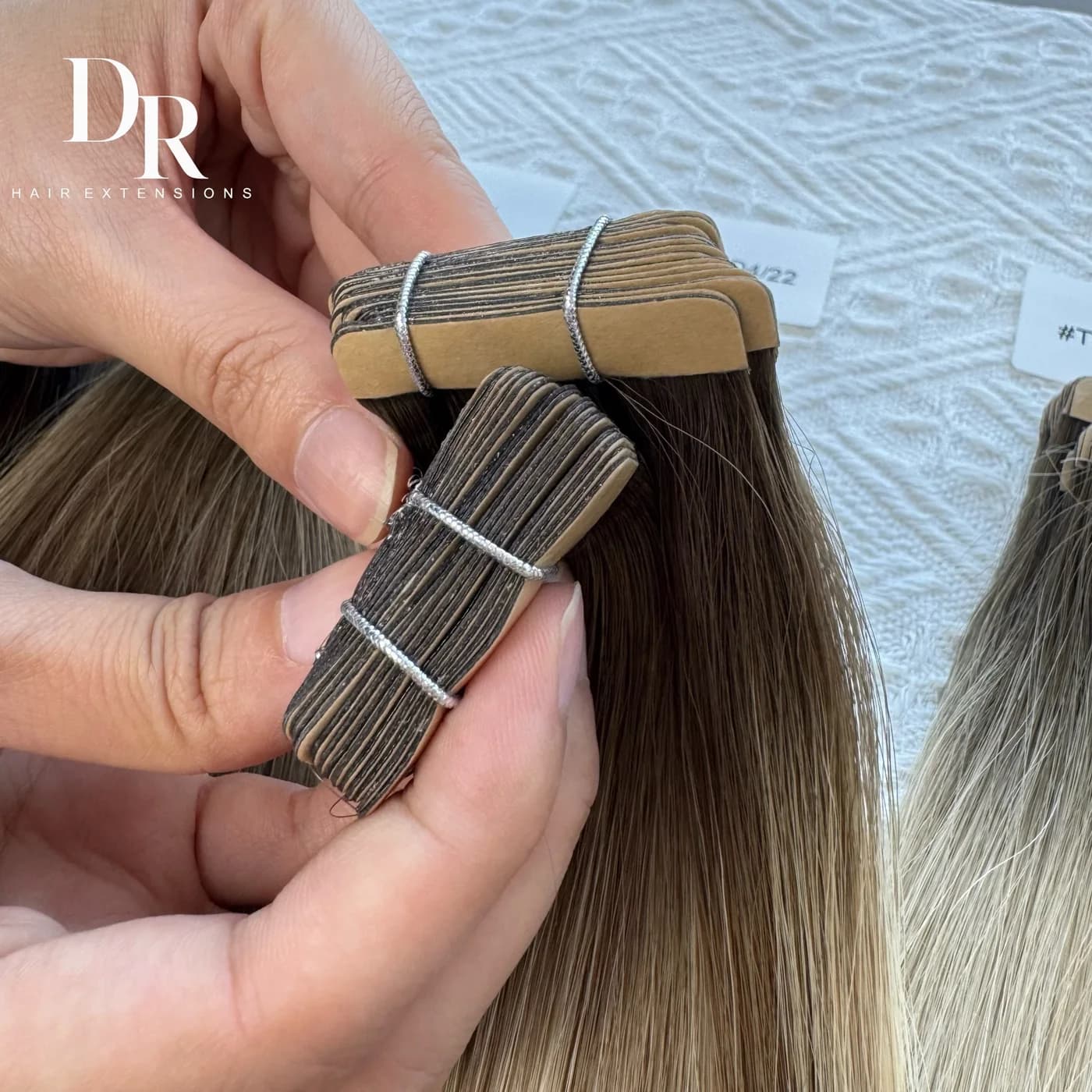
Tape-ins use flat adhesive attachments. Their footprint differs from an individual ring or bond, so ask the stylist to assess the complete tab, covering hair and intended placement together. A flat shape alone does not prove that the attachment will stay hidden.
DR's regular Tape-in Hair has a standard 100g pack containing 40 individual tabs, with 4 × 0.8cm attachments. That averages approximately 2.5g of hair per tab. When two standard hair-bearing tabs form a pair, they represent approximately 5g of hair; this arithmetic is not a prescribed installation load.
Confirm whether a quotation counts individual tabs or installed pairs. Forty tabs should not be interpreted as forty two-tab placements. The number installed depends on the client's assessment, not the number supplied in a pack.
Does invisible tape automatically mean lighter tape?
No. DR's Invisible Tape Hair uses specialized root construction for a more scalp-like appearance, while its standard pack also contains 100g and 40 tabs. A different root finish does not automatically reduce the hair weight per tab. Review the distinction in our Invisible Tape versus regular Tape-in guide.
If a stylist proposes single-sided application, ask which approved backing and fitting instructions the system requires. Do not improvise with a standard tab or assume an unlisted accessory is included. Removal, replacement tape and refitting arrangements should be agreed before installation.
Nano rings for fine hair: tip size and strand weight are separate
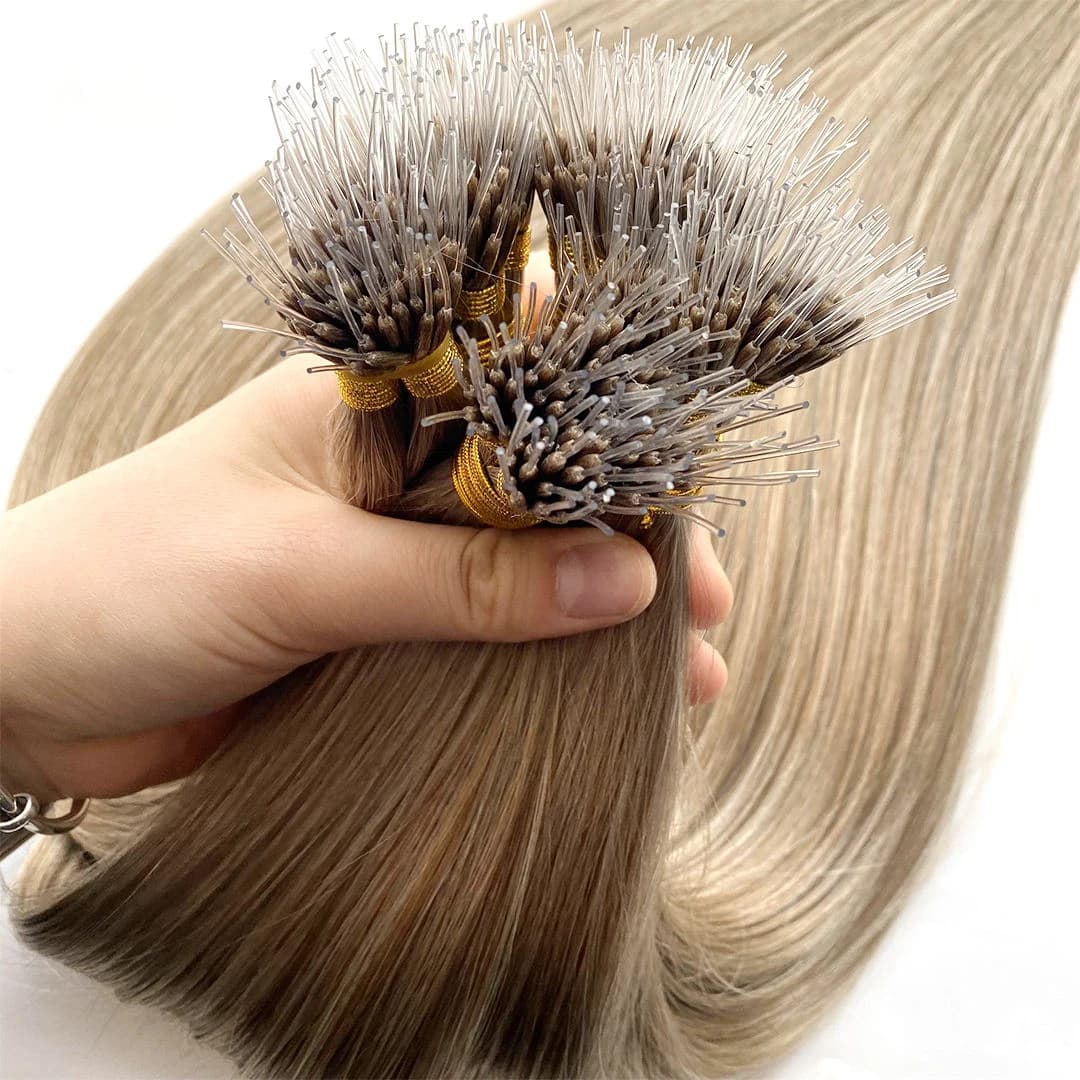
Nano ring or nano bead terminology commonly describes a small-ring, individual-strand fitting method. The name alone does not tell you the strand weight, tip material or ring compatibility. A discreet-looking tip can still carry more hair than a particular natural section should support.
DR's Nano Ring Hair comes as 100 strands at 1g each in its standard 100g pack. Options of 0.5g and 0.8g per strand are available by request. Ask the stylist which specification to evaluate; lower unit weight is one selection variable, not a guarantee of suitability.
Keep the pack arithmetic clear. One hundred 0.5g strands total 50g, while one hundred 0.8g strands total 80g. Maintaining 100g would require a different strand count. These examples explain quotation formats, not how many strands a client should wear.
Confirm the tip, ring and removal plan
DR's standard tip has a metal loop, with plastic or thread constructions available by request; nano rings are included. Fitting uses no heat or added adhesive, although adhesive secures the hair to the tip during manufacturing. Calling the entire product glue-free would therefore be misleading.
Review the selected tip and matching ring on a sample. Ask how the stylist will check placement, manage regrowth and remove or refit the strands. Our Nano Ring salon guide covers those specification questions in more detail.
Weft extensions for fine hair: assess the complete row
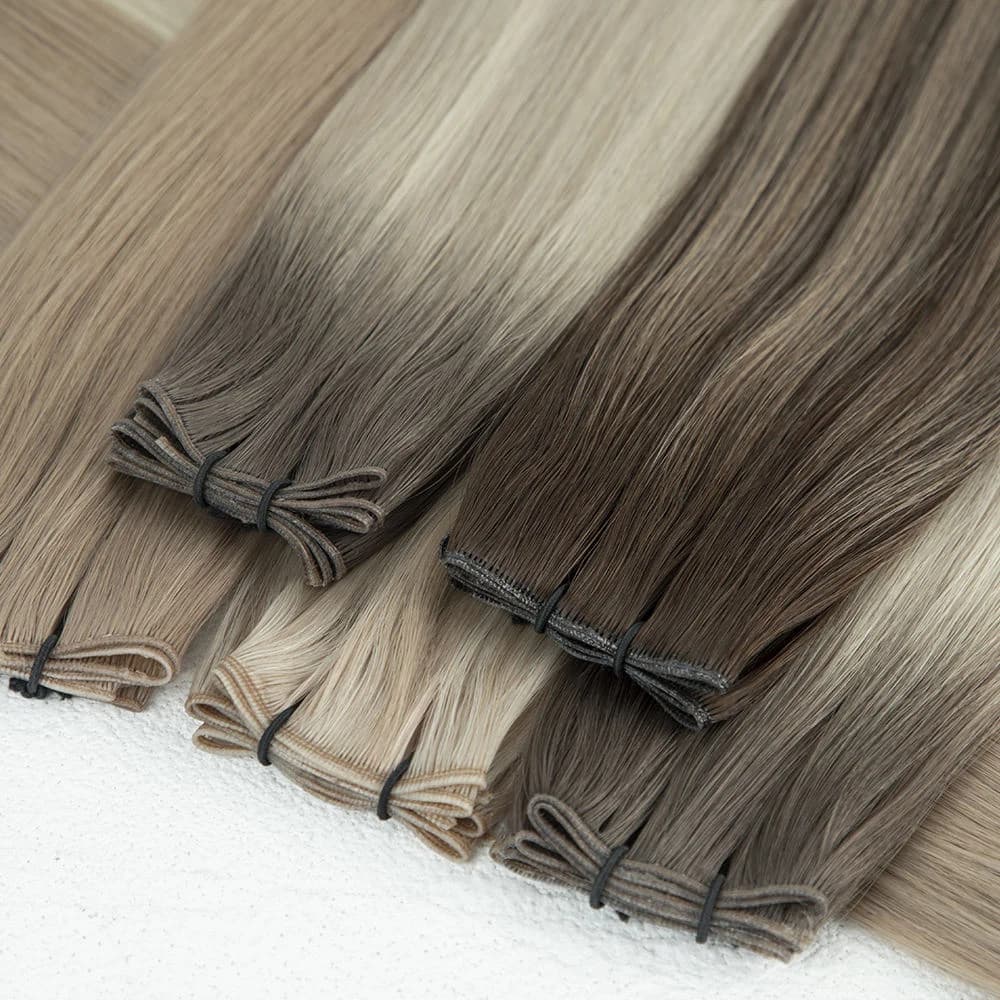
A thin weft seam can be useful for reducing visible bulk, but the seam is only part of the attachment. Beads, thread, the fitting method and stacked wefts all contribute to the finished row. Assess that whole arrangement beneath the intended covering hair.
DR's Genius Weft is a thin, flexible weft for professional beaded or sew-in installation. A standard 100g pack can contain two, four or five wefts, averaging 50g, 25g or 20g per piece respectively. More pieces divide the same pack differently; they do not reduce its total weight.
The row load depends on what is actually fitted. Stacking three 20g pieces places 60g of extension hair into that arrangement before accounting for fitting accessories. The calculation helps compare plans, but it cannot establish a safe row weight or attachment count for a person.
Hand tied versus tape-in is not just a seam comparison
Hand tied describes a weft construction; tape-in describes an adhesive attachment format. Ask how the proposed weft will be secured, whether resizing is allowed and how much stacking the plan requires. Do not transfer cutting instructions between hand-tied and other constructions.
Our Genius, hand-tied and machine-weft comparison separates those construction questions. If evaluating a perforated band instead, the Butterfly Weft guide for fine hair explains its distinct buying considerations. Neither label replaces a coverage assessment.
K-tip extensions for fine hair: agree the bond specification
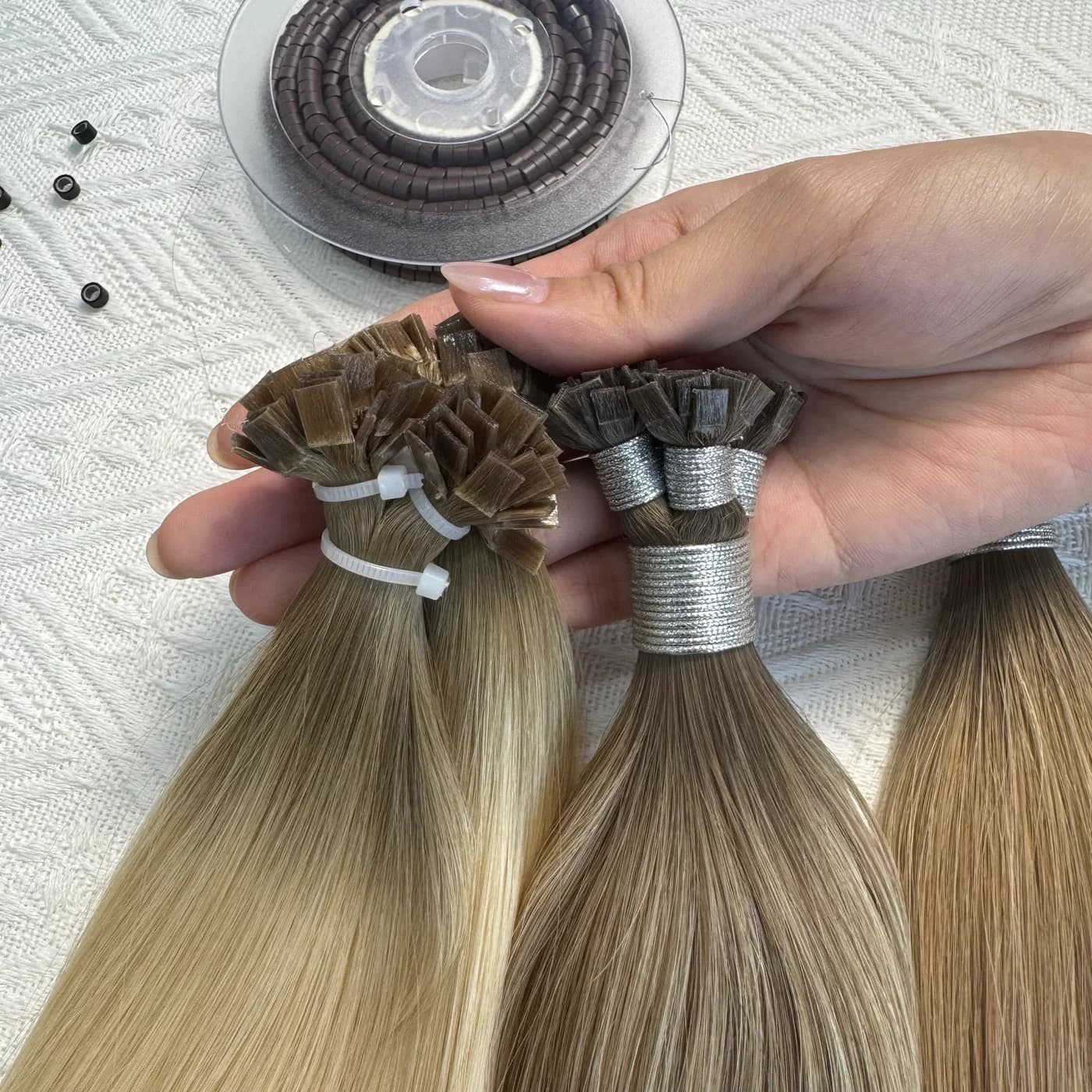
Individual keratin bonds allow the stylist to plan strand placement separately. They also require professional fusion fitting and appropriate removal. Ask about the hair carried by each bond, the finished attachment profile and the natural section supporting it.
DR's K-tip / Flat Tip Hair uses professional heat fusion. These are two names for the same product in our collection. Standard packs contain 100 strands at 1g each; custom strand weights and counts can be agreed when ordering.
Do not assume a standard 1g strand is a micro-bond suited to every fine-haired client. Discuss a different specification before ordering if required. The supplier and stylist should agree any permitted customization rather than relying on an improvised bond-cutting instruction from another brand.
Occasional volume may call for a removable option
For an event or occasional fullness, compare a limited clip-in layout before committing to an ongoing fitted service. Removability can suit that use case, but clips still need enough suitable natural hair for support and concealment.
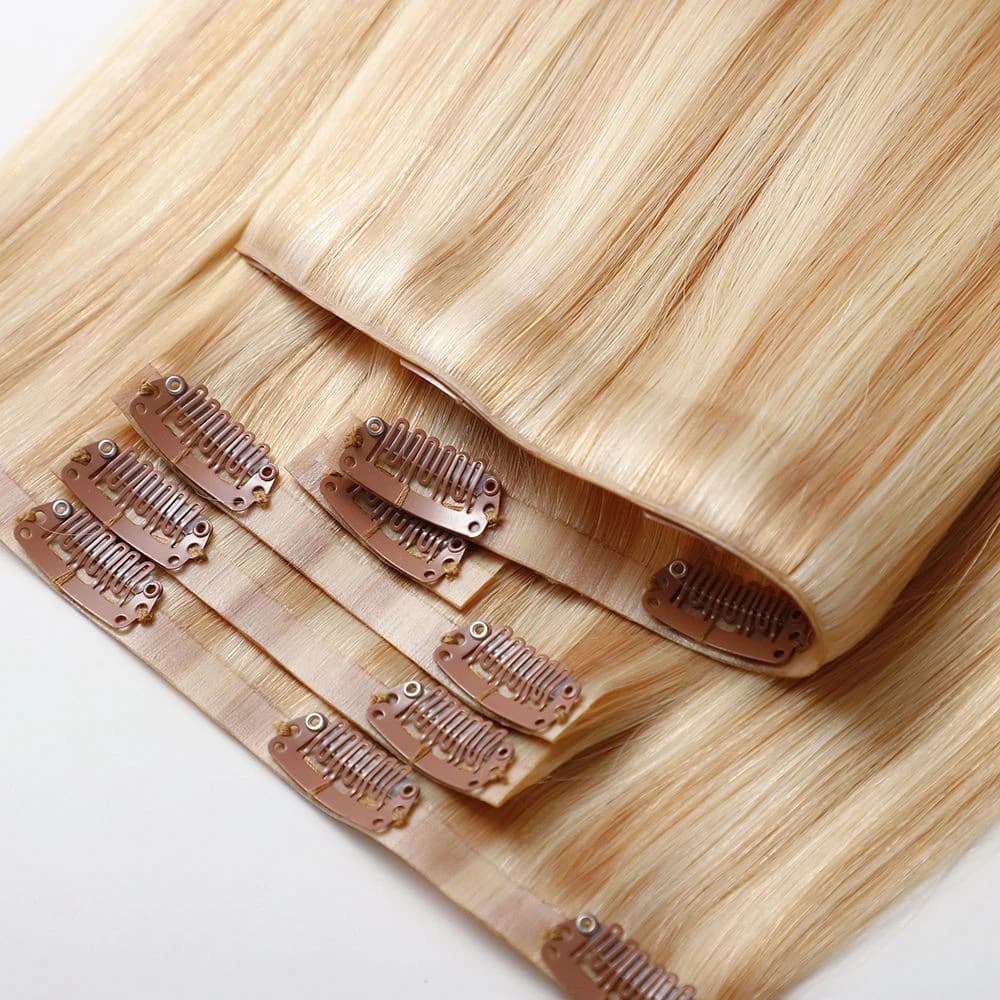
Evaluate the piece width, base, clip layout and total weight together. A thin PU base does not automatically mean a lighter complete set. Avoid placing pieces on fragile edges or forcing every supplied piece into the hairstyle. Remove temporary clip-ins before sleeping and follow the product's care instructions.
Our clip-in guide for fine hair compares standard and PU bases, coverage and set planning. A removable attachment is an option to assess, not a workaround for an unsuitable scalp or hair condition.
Match texture, shade and end fullness as carefully as the method
Remy hair extensions for fine hair still need a physical match. The hair option does not, by itself, specify fiber thickness, attachment weight or suitability. Ask what the selected option means and review the actual supplied sample.
Compare movement and texture with the natural lengths, then check the ends. Very full extensions can create a dense-looking lower section that the client's own hair does not blend into. Our single drawn versus double drawn guide explains that separate choice without treating either description as a universal quality grade.
Use a physical color reference, checking roots, mid-lengths and ends. For highlighted clients, assess dimension and root transition instead of matching only the palest strand. The blonde weft color guide provides a more detailed matching process.
Approve samples before expanding a salon collection
Installation preparation starts with a written specification: method, construction, hair option, shade, length, texture, unit weight, piece count and total pack weight. Record the proposed product application and ask the stylist to review the sample before fitting it.
DR's published US salon sampling experience describes a stylist purchasing a physical color ring and 300g across Genius Weft, tape-in and flat-tip formats. She assessed the products through installations, washing and styling before developing repeat orders. It illustrates a sampling workflow, not a controlled fine-hair trial or a result promised to every client.
For factory testing and shipment inspection, distinguish manufacturing checks from wearer assessment. DR's confirmed QC process includes production-stage checks and individual pack weighing. Final sampling checks weight, ruler-measured length, color under dedicated lighting, shedding and smoothness; a sampled nonconformity triggers full reinspection of the affected shipment.
Those checks do not establish a person's safe attachment load. Add any specific customer requirements to the approved order, and keep sample references and shipment labels identifiable for replenishment.
Compare the service commitment before comparing price
Request a quote covering the hair, installation, blending, scheduled reviews, removal, refitting supplies and potential replacement hair. The lowest initial hair price may not describe the full service cost. Ask what is included rather than comparing unrelated package totals.
Have the stylist set the review schedule for the selected method and client's growth, placement and care. Maintenance is not permission to leave an uncomfortable attachment until the next appointment. Ask for written home-care and removal arrangements, including support while traveling.
Wholesale buyers should separate order quantity from fitted quantity. A 100g purchasing minimum is not a recommendation to install 100g on one client. Confirm stock, custom production and shipping separately for the chosen product before scheduling appointments in the United States, Europe, Canada or Australia.
Frequently asked questions
Are tape-ins the best extensions for fine hair?
They can enter the shortlist when the natural hair can support and cover the selected tabs. Compare the actual tab format, intended placement and maintenance requirements with other options. Flat attachments alone do not establish the best choice for an individual.
Are nano beads better than tape-ins for thin hair?
Neither is universally better. Nano rings use individual placements; tape-ins use a flat tab format. Compare strand or tab weight, supporting sections, visible coverage and the stylist's fitting plan. Sparse coverage can limit either option.
Can fine hair support Genius Weft extensions?
Some clients may be suitable after professional assessment. The relevant questions are total fitted row weight, attachment arrangement, stacking and available covering hair. A thin seam or a five-piece pack does not establish a safe installation plan.
Are K-tip extensions always lightweight?
No. Confirm the weight per strand and total planned quantity. DR's standard K-tip strand is 1g, with custom weights available by agreement. Individual placement does not mean every supplied bond is appropriate for every fine-haired client.
How many grams should I buy for fine hair?
First obtain the stylist's fitting plan. Desired length, natural density, condition and placement all affect the quantity. Keep the amount purchased, the pack configuration and the amount installed distinct; there is no universal gram recommendation for all fine hair.
Will extensions fix thinning hair?
Extensions add cosmetic fullness and do not treat its cause. New or unexplained thinning should be assessed before adding attached hair. A dermatologist and an extension professional address different parts of that decision.
Conclusion
Choose hair extensions for fine hair by matching the attachment, fitted weight, coverage and maintenance commitment to the individual. Tape-ins, nano rings, wefts, K-tips and clip-ins offer different formats; the useful comparison is the complete fitting plan. Approve a sample, preserve its specification and let the consultation determine the result you pursue.
HAIR EXTENSION SOURCING
Request a hair extension specification or quote.
Share your shade references, lengths, texture, quantities and preferred pack format. Fields marked with * are required.