
BUYING GUIDE
Genius Weft vs Hand-Tied vs Machine Weft: A B2B Buyer’s Sourcing Guide
Compare genius, hand-tied and machine weft hair extensions for salon, wholesale and private-label sourcing. Learn what to sample, specify and inspect before ordering.
Introduction
For a salon distributor, extension brand or wholesale buyer, “weft hair” is not a single buying decision. Genius wefts, hand-tied wefts and machine wefts can all support professional installations, but their seam construction, handling expectations, pack format and target price position are different. Choosing by product name alone is risky because the same label can describe noticeably different products from different suppliers.
The practical question is not “Which weft is best?” It is: which weft construction fits your installation method, client profile, price tier and quality-control process? A low-profile seam may matter most for a salon program serving fine-hair clients. A robust, familiar construction may make more sense for a value-led wholesale range. A premium brand may need two constructions rather than one, so stylists can choose based on the service plan.
This guide explains the commercial and technical differences without treating any construction as automatically superior. It also shows what a B2B buyer should request in a sample, what to confirm before production and what to inspect before shipment.
**Quick answer:** Genius wefts are generally selected for a thin, flexible and often cuttable seam; hand-tied wefts are selected when a lightweight hand-tied construction is part of the desired service; machine wefts are selected when a more traditional, robust and often cost-efficient format fits the collection. Verify the actual seam, cutability, weight, return hair and installation guidance for every supplier—not just the category name.
Start with the construction, not the marketing name
The word “weft” describes hair attached along a continuous top edge. It does not describe the installation method by itself. Beaded-row, sew-in, hidden-row and similar terms usually describe how a stylist attaches one or more wefts to the client’s natural hair. A buyer should specify both the product construction and the intended application method.
Genius or flat weft
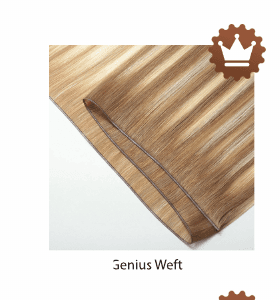
“Genius,” “flat,” “micro” and “seamless” are often used as overlapping commercial descriptions. In the market, a genius-style weft is commonly expected to have a fine profile and flexible top edge, with fewer visible short return hairs than a traditional hand-tied construction. Many buyers also expect it to be cuttable, but that expectation must be confirmed, not assumed.
For sourcing, ask the supplier to state:
- the seam material and approximate profile;
- whether it may be cut anywhere, and whether cut ends need sealing;
- whether short return hair is present at the seam;
- the standard width and net weight per bundle or pack;
- which textures and lengths use the same construction;
- recommended handling during installation, washing and reinstallation.
A thin-looking edge in one product photograph does not answer these questions. The most useful sample is a full working piece: a stylist or trained product evaluator can bend the seam, view it against a light background, make an approved cut if applicable and inspect the cut edge after light handling.
Hand-tied weft
Hand-tied wefts generally refer to hair tied along a thread-based foundation. Depending on the construction, short “return” hair can appear along the top edge. Some buyers prefer this familiar hand-tied format for specific salon programs, especially where the stylist’s training and installation method were designed around it.
The business decision is not simply whether a hand-tied weft is more premium. It is whether the product works with the intended installation protocol, service time and client expectations. A buyer should check how the edge lies when layered, how it behaves when folded, whether it should be cut, and what the supplier permits at the ends.
Machine weft
Machine wefts generally use a sewn or machine-formed top construction. They can offer a more substantial seam and are often available in a broad range of hair types, lengths and weights. For some markets, this makes them a practical foundation SKU: familiar, straightforward to stock and suitable for stylists who work with traditional weft systems.
The trade-off is not universal. A machine weft may be the most sensible option when the collection prioritises dependable format, a particular density, a longer continuous track or a target wholesale price. It may be less appropriate where the entire value proposition is an ultra-low-profile install on very fine hair. The answer depends on the product sample and the service model.
Side-by-side comparison for wholesale planning
| Decision factor | Genius / flat weft | Hand-tied weft | Machine weft |
|---|---|---|---|
| Seam expectation | Fine and flexible; verify actual profile | Thread-based hand-tied edge | More substantial sewn or machine-formed edge |
| Cutability | Often requested; must be confirmed | Follow supplier instructions | Often cuttable, but verify end finishing |
| Return hair | Often marketed as minimal or absent | May be present depending on construction | Varies by construction |
| Common buyer use | Low-profile salon and premium private-label ranges | Program-specific salon ranges | Broad wholesale or traditional weft ranges |
| Key sample check | Cut edge, flexibility and seam visibility | Edge feel, return hair and layering | Seam bulk, density and handling |
| Main sourcing risk | Treating “genius” as a universal standard | Assuming all hand-tied products handle alike | Buying on price without checking seam and hair consistency |
This table is a starting point, not a substitute for a sample. Two genius wefts can differ in seam materials, width, weight distribution and approved cutting method. The category helps shortlist; a specification sheet and inspection process decide whether the SKU is suitable for sale.
Build the product brief before asking for a quotation
A productive B2B quote request contains more than length and colour. Buyers who provide a clear brief get more comparable offers and reduce the risk of receiving an item that technically meets a name but misses the intended use.
Include these points in your request:
- **Target customer and channel.** Is the range for salon professionals, online resale, distributors or a private-label launch? Describe the target price position rather than asking only for “best quality.”
- **Construction and application.** Name the desired weft category and the installation method your customers use. Ask the supplier to flag any mismatch.
- **Hair presentation.** State texture, length range, colour family, blend requirements and desired net weight. Do not assume a “20-inch pack” carries the same density between suppliers.
- **Packaging and labelling.** Include pack format, barcode or SKU requirements, colour-label system, insert cards and outer-carton expectations.
- **Quality checkpoints.** Ask what will be checked before packing and what evidence can be shared, such as quantity count, colour reference, length confirmation, seam close-ups and carton labels.
- **Sample decision.** Define who will review the sample, what is being approved and whether production may start only after a written sample confirmation.
An effective brief creates a reference point for both parties. If a buyer later asks why a shipment looks different from the approved sample, the answer should be traceable to agreed colour, texture, construction, length, weight and packaging requirements.
What to inspect in a weft-hair sample
Inspect the hair and the seam separately
Buyers sometimes judge only the hair fibre and overlook the top construction. Inspect both. For the hair, look at colour consistency, visible processing residue, tangling during gentle finger-combing, end density and texture uniformity. For the seam, check straightness, flexibility, loose areas, edge finish and any short return hairs relevant to your target customer.
Avoid dramatic claims such as “no shedding” or “zero tangling.” Hair is a natural material and performance depends on processing, installation, client care, environmental exposure and handling. A more credible approach is to document the condition of the approved sample, define the inspection method and train buyers or stylists to report issues with photos, batch details and installation context.
Use an installation-preparation check
Before approving a salon SKU, ask a qualified stylist or internal evaluator to review it in the way it will actually be used. Installation preparation can include checking colour blend against a swatch, separating the appropriate amount of hair, positioning the weft along the planned row and confirming whether the edge can be trimmed under the supplier’s instructions.
This step does not require a dramatic laboratory test. It requires a repeatable observation: does this construction behave as expected for the intended service? Record the result, the texture, length, colour and product code. This becomes useful evidence when future samples or reorders are compared.
Check pack weight and usable format
Net weight should be stated clearly, but buyers should also consider usable presentation. A pack can meet a stated weight while differing in track width, density distribution or end appearance. Ask for the measurement method and whether the quoted weight excludes packaging. For a multi-length range, confirm whether the bundle presentation changes as length increases.
Use a shipment-inspection checklist before goods leave
The final shipment inspection should reflect the approved sample and purchase order—not a generic “quality passed” statement. A practical inspection can cover:
- correct product name, colour code, texture, length and net-weight presentation;
- visible seam condition and quantity count by SKU;
- packaging artwork, labels, inserts and barcode placement;
- random carton checks for mixed SKU accuracy;
- clear photographs or video of representative products and labelled cartons;
- confirmation of any approved deviations before dispatch.
For repeat orders, keep the same reference set: sample photos, product code, colour standard, pack specification and inspection notes. Consistency over time is one of the most important purchasing criteria for a salon or brand. It is also why a buyer should not change several variables at once. If you change the hair source, colour process, packaging and weft construction in one order, it becomes difficult to identify the cause of a later issue.
Which weft should your business stock first?
Salon-led collections
Start with the construction that your stylists already understand and can install safely. If low profile and flexible handling are the central customer request, compare genius-style samples carefully. If your salon partners have a well-defined hand-tied program, a compatible hand-tied option may be a better first SKU. Add other constructions only after the core range is stable.
Distributor or wholesaler collections
Distributors usually need clearer segmentation. A useful structure may be a practical machine-weft range, a low-profile genius/flat range and a premium salon-oriented option. The difference between tiers should be explained with construction, intended use, packaging and service—not unsupported superlatives.
Private-label brands
Private-label buyers should begin with a limited assortment: a small colour family, selected lengths and one or two constructions. The brand can expand after it has reliable reorder data. Launching every texture, colour and length at once creates complex stock, unclear quality comparison and avoidable packaging mistakes.
FAQ
### Is a genius weft always better than a hand-tied weft?
No. Genius is not a universal construction standard, and “better” depends on the seam, approved cutting method, intended installation and client needs. Compare actual samples and supplier instructions.
### Can every genius weft be cut?
Do not assume so. Ask the supplier whether it can be cut, where it can be cut and whether the cut edge needs sealing or another finish.
### What should a wholesale buyer ask for before placing a bulk order?
Ask for a product specification, representative sample, net-weight definition, colour and texture reference, packaging proof, production lead-time confirmation and shipment-inspection plan.
### Are hand-tied and installation method the same thing?
Not necessarily. Hand-tied commonly describes the product construction. Terms such as beaded row or sew-in may describe the installation method. Confirm both.
### How can a buyer reduce repeat-order variation?
Approve a documented reference sample, maintain SKU and packaging specifications, inspect representative finished goods before shipment and record any agreed changes in writing.
Conclusion
Genius, hand-tied and machine wefts can all be commercially valuable. The strongest B2B decision comes from matching construction to the target service and documenting what “approved” means. Product names help customers navigate a range; written specifications, sample review and shipment inspection protect the range after launch.