BUYING GUIDE
100% Remy Human Hair Extensions: What to Check Before Buying
Understand Remy, virgin and human hair claims. Compare extension formats, processing, sample checks and specifications before buying.
Introduction
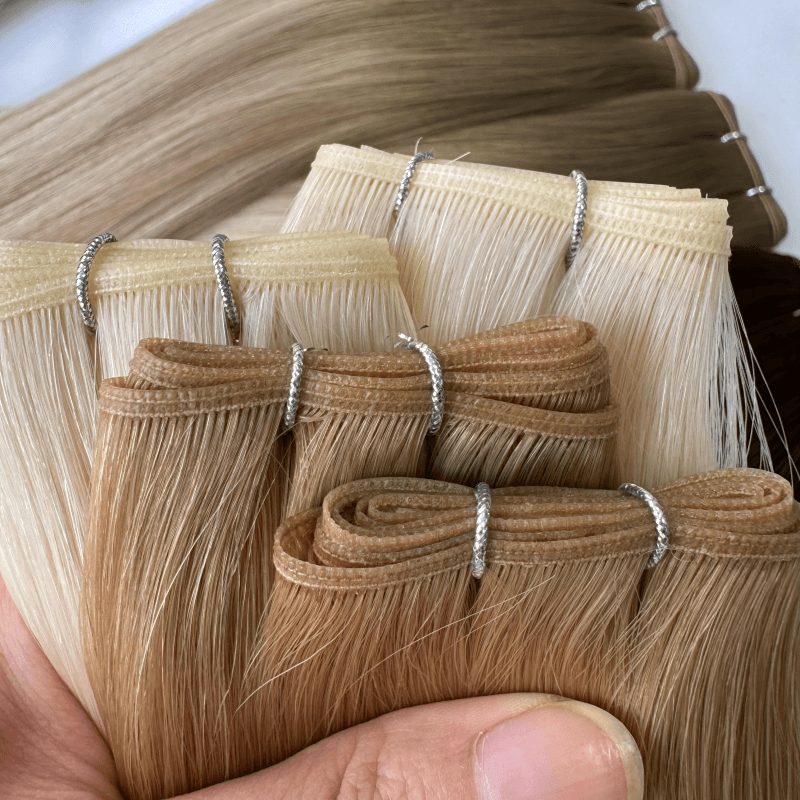
100% Remy human hair extensions describe human hair fibers prepared with their cuticles preserved and oriented in the same root-to-tip direction. The words address material and alignment; they do not tell you the complete processing history, attachment format or appropriate installed quantity.
For a buyer, the next step is to confirm what those claims mean for the actual product. Ask about the selected shade and texture, review the hair through its full length, and check the tabs, weft, tips or clip-in base on a sample. A shiny photograph or a familiar label cannot replace that specification.
This guide explains the terms and a practical approval process for salon and wholesale orders. DR Hair Extension publishes it as a manufacturer and wholesale supplier using our current catalog, confirmed inspection procedures and named professional sources. We offer Virgin Hair and Remy Hair options; confirm the selected option and processing description for the product you order.
What does 100% Remy human hair mean?
Read the description as two related claims. 100% human hair concerns the hair fibers' composition. Remy concerns the cuticles and their direction. The percentage does not mean the clips, tape, thread or bond material are human hair.
Great Lengths explains Remy hair through cuticles aligned from roots toward ends. Hair & Compounds' quality description also describes retaining the cuticles rather than stripping them, with the hair oriented consistently. These manufacturers' explanations support the terminology; their own sourcing and performance claims do not become specifications for another brand.
Why cuticle direction matters
The cuticle is the hair strand's outer layer. Consistent orientation can support smoother handling by reducing friction between opposing cuticle surfaces. It remains one part of finished product quality: processing, hair condition, construction, fitting and care also affect the result.
Avoid interpreting Remy as a promise that the extensions never tangle or need no maintenance. Ask the supplier to explain cuticle condition and processing alongside the alignment claim, then evaluate the selected sample under the intended care routine.
Does “100” mean 100g?
No. In a description such as “100% Remy human hair,” the percentage concerns the material claim. 100g is a product weight, while 100 strands is a piece count. All three can appear on one pack and describe different things.
Remy, virgin, non-Remy and double drawn compared
These terms answer separate questions. Combining them into one quality ranking can hide details that matter for a salon service.
| Term | What it commonly describes | What to ask next |
|---|---|---|
| 100% human hair | Hair-fiber composition | What supporting product information is available? |
| Remy | Preserved cuticles with consistent root-to-tip orientation | What is the cuticle condition and processing history? |
| Non-Remy | Hair without the same Remy alignment description | How is it sorted and processed, and what condition is supplied? |
| Virgin | A claim about absence of specified chemical processing | Which treatments are excluded, and does this describe the supplied color? |
| Single or double drawn | Distribution of strand lengths and end fullness | Which sample or end profile will the order match? |
| Single donor | A claim about donor count | What traceability supports that specific claim? |
SL Raw Virgin Hair's explanation distinguishes cuticle alignment from raw or virgin processing descriptions. Remy hair can be supplied in colored or textured forms. A Remy label alone therefore does not establish an uncolored history.
Non-Remy does not automatically mean synthetic: human-hair composition and cuticle organization are different questions. Likewise, Remy does not automatically mean single donor or establish a country of origin. Request the information relevant to your purchase rather than inferring it from a material label.
For length distribution, see our single drawn vs double drawn guide. Fuller ends and aligned cuticles should be evaluated separately.
What changes when you choose blonde, rooted or textured hair?
Describe the finished product you need: root depth, mid-length shade, end tone, texture and length. Ask how that specification is produced and what processing description applies to it. A broad collection name should not replace details for the actual shade.
With a light blonde or dimensional blend, compare a physical color reference in consistent lighting. Check the roots and ends separately. Screen brightness and photographic lighting can change how warm, cool or dense the hair appears.
For a wave or curl, ask how the pattern is created and how the selected sample should be washed, dried and maintained. Compare it with the client's natural texture in the state they intend to wear it. A styled photograph alone does not establish the hair's behavior after washing.
Can Remy extensions be colored or heat styled?
Confirm the permitted treatments for the selected product with the supplier and stylist. Human-hair composition is not a blanket instruction to bleach, recolor or use an arbitrary styling temperature. Previous processing and the attachment system also matter.
If further color work is planned, have the professional evaluate a sample using an agreed strand test before committing the order or treating a complete set. Record the product, process and observed result. That is a proposed approval step, not a claim that DR has completed the same test for every possible treatment.
Choose the extension format as well as the hair option
Remy describes the hair; Tape-in, Genius Weft, K-tip and Clip-in describe how the finished product is supplied and used. Choose both parts of the specification.
| DR product | Current standard or listed format | Buying decision beyond the Remy option |
|---|---|---|
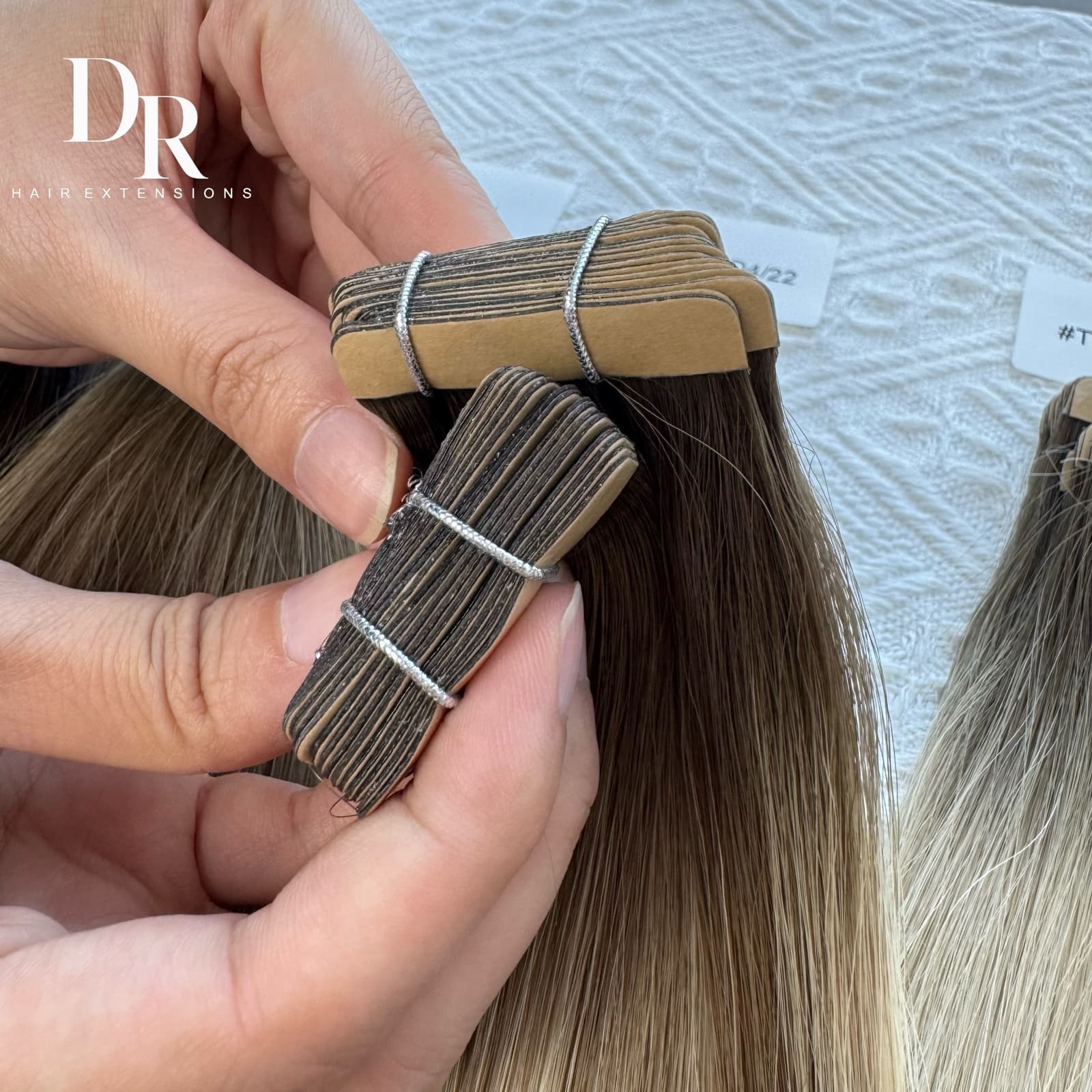
| Tape-in Hair | 100g / 40 individual tabs; 4 × 0.8cm attachment | Tab count, adhesive specification, placement and refitting |
| Genius Weft | 100g divided into 2, 4 or 5 wefts | Piece weight, unfolded width and professional row plan |
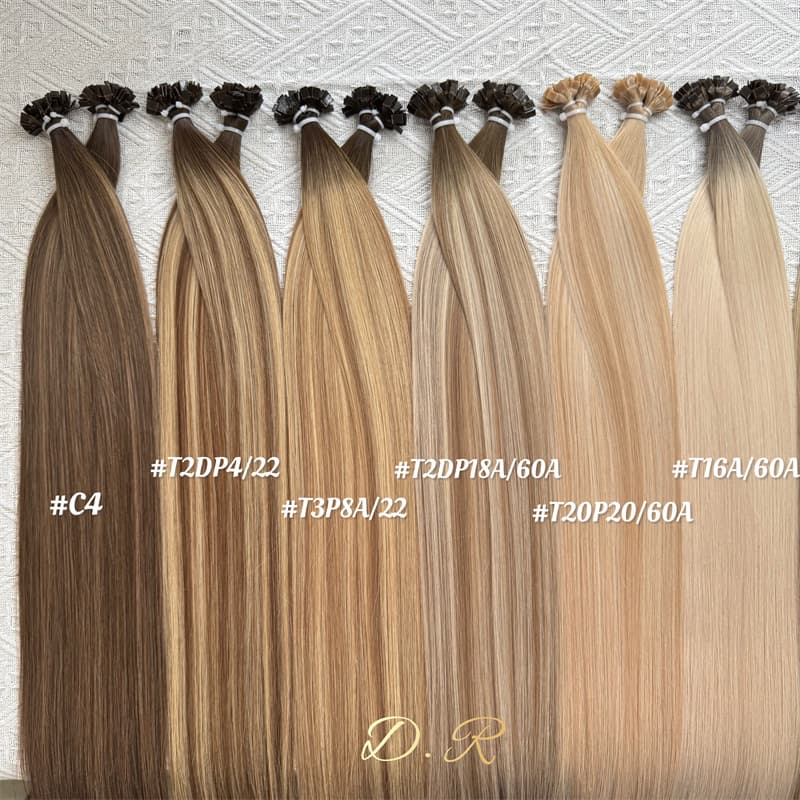
| K-tip / Flat Tip Hair | 100g / 100 strands / 1g each | Strand weight, bond specification and professional fusion plan |
| Clip-in Hair | 100g, 120g, 160g or 180g sets; custom piece counts | Base, panel widths, clips and temporary coverage |
The table describes purchasing formats, not the amount to fit on a particular client. Review the actual construction and hair condition with the professional who will use it.
Remy tape-in extensions
DR Tape-in Hair averages approximately 2.5g per individual tab in its standard format. If two hair-bearing tabs are paired, that pair contains approximately 5g. Forty individual tabs should not be read as forty two-tab placements.
Confirm the selected adhesive and care instructions on the sample. The Remy option does not establish tape compatibility, a refitting interval or a guaranteed number of applications. Our tape-in maintenance guide covers those lifecycle questions.
Remy wefts and individual bonds
For Genius Weft, confirm total pack weight and the supplied piece format together. A 100g pack divided into five pieces contains the same total hair as one divided into two. The average supplied piece weight changes, and the stylist still needs an appropriate row plan.
For K-tip / Flat Tip Hair, DR's standard 1g strand is a specification to assess, not a universal fitting size. Custom strand weights and counts can be discussed together. Ask the stylist to approve the selected bond and removal arrangements before installation.
How to evaluate a Remy hair sample before ordering
Use a written sample record so that the approval can be linked to the later shipment. Keep the original product reference and note any treatment you perform.
Start with identity and measurements
Record the hair option, method, shade, texture, length, total weight and supplied piece count. Confirm what is included in the weighing basis, particularly for products with clips or other attachments. Compare the label with the agreed quotation.
Examine the full lengths and ends, not only the top of a folded bundle. Photograph the sample against a consistent background and inspect the seam, tabs or tips separately. A ruler and scale support dimensional checks; they do not establish fiber composition or cuticle alignment by themselves.
Agree a wash-and-dry evaluation
Follow the selected product's instructions and use a consistent, documented routine for the samples being compared. Record the care products, handling and drying method. Assess detangling, visible shedding, feel, color and texture presentation after the agreed routine.
This is a practical salon comparison, not a universal laboratory authenticity test. If composition or cuticle verification is a critical purchasing requirement, ask what supporting records or appropriately qualified independent testing can address the specific claim.
Separate hair behavior from attachment behavior
If an issue appears, identify whether it concerns the lengths, color, seam, tape or individual tip. A product with good-looking hair can still have an attachment that does not meet the intended application requirements.
Before product application, the stylist should approve the complete sample and fitting plan. Installation preparation includes the selected system's instructions, the desired result and the client's ability to follow the maintenance routine. Keep those observations distinct from assumptions based on the word Remy.
Turn approval into a repeatable order reference
Write down what was approved before placing the larger order. Include the sample reference, hair option, shade code, texture, length, end profile, weight and attachment format. Identify any processing information or additional evidence that formed part of the decision. Keep an untreated reference where practical, and label any sample altered during a wash or color evaluation.
For later deliveries, compare matching specifications under the same conditions. A wet sample and a dry sample, or two different lengths and textures, do not provide an equal comparison. If the supplier proposes a change to the approved product, review that change before treating it as an interchangeable replenishment.
When reporting a concern, provide the order and sample references, affected quantity, photographs and the care or treatment used. This gives the supplier a concrete issue to investigate. It also keeps a construction concern, shade mismatch or handling difference from being reduced to an unsupported claim about the entire material category.
What DR checks during production and before shipment
DR's confirmed quality-control process includes checks at each production stage and weighing every pack against the agreed specification. Final sampling covers weight, ruler-measured length, color under dedicated inspection lighting, shedding and smoothness. If a sample reveals a nonconformity, the affected shipment is fully reinspected.
These factory testing and shipment inspection procedures support conformity checks before dispatch. They are not a published microscopic cuticle assay, composition certificate or controlled wear trial. Agree any additional evidence or acceptance requirement before ordering rather than assuming it is included.
Our documented US salon sampling experience began with a color ring and a 300g selection across Genius Weft, Tape-in and Flat Tip hair. Product examination, installation, washing and styling informed later orders. It illustrates an evaluation process; it does not establish a universal result or lifespan for every Remy product.
Compare quotations and set realistic maintenance expectations
Compare the same hair option, method, shade, texture, length, end profile, weight and piece format. A lower pack price may describe a different specification. Ask whether delivery, custom packaging or other agreed items are included.
For DR regular Tape-in and K-tip orders, the minimum is 100g per color and length. Paid sample hair uses wholesale hair pricing, with delivery quoted separately. Other collections have their own order terms, so confirm the exact product before applying one range's policy to another.
The hair's usable condition and an installed attachment's service interval are separate questions. DR Tape-in reuse requires replacement tape and professional assessment. K-tip care, removal and any reapplication require the selected professional guidance. Clip-in pieces also need their hair, base and clips assessed before continued use.
Keep hair purchase, fitting, maintenance and removal in separate budget lines. Our professional extension cost guide explains how to compare the complete service rather than a hair-only price.
Remy clip-ins for temporary wear and salon collections
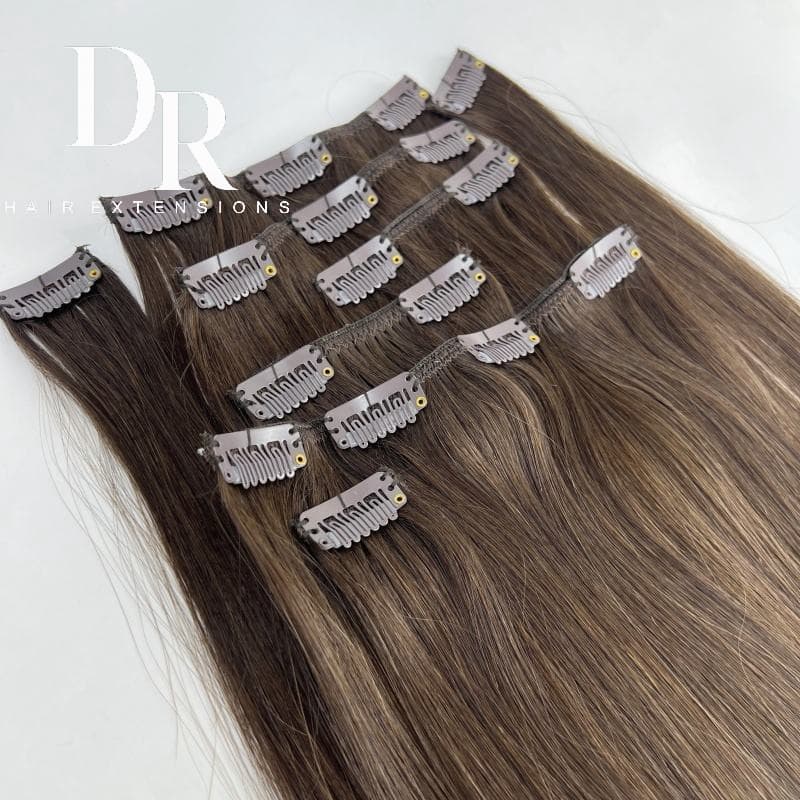
For occasional volume or styling, DR Clip-in Hair combines a machine-weft base with metal clips. Piece counts are customized, so approve the panel widths, clip positions and set weight together. The Remy option does not specify that layout automatically.
A panel carrying three clips remains one extension piece. More pieces do not necessarily mean more grams: the same weight can be distributed across a different layout. Confirm the intended coverage and support instead of fitting every supplied panel simply to use the complete set.
For a salon collection, retain the approved layout and shade reference so replenishment orders can be compared consistently. The clip-in selection guide provides a fuller discussion of base construction and coverage.
Frequently asked questions
Is 100% Remy hair real human hair?
That is the composition claim. Remy additionally describes preserved, consistently oriented cuticles. Ask for the supplier's product description and supporting information, then approve the selected sample. The label alone does not explain every processing step or finished attachment.
Is Remy hair the same as virgin hair?
No. Remy concerns cuticle direction and condition; a virgin claim concerns processing history. Confirm what the supplier means for the actual shade and texture. Colored Remy hair should not be assumed to have an unprocessed history.
Can I identify Remy hair from a photograph or softness?
Appearance and touch help assess presentation but cannot establish all material claims. Use a written specification, an agreed sample evaluation and supporting evidence appropriate to the requirement. A smooth first impression is not a complete verification process.
Does Remy mean double drawn or single donor?
No. Drawn type concerns strand-length distribution, while donor count is a separate sourcing claim. Ask for the selected end profile and any donor or origin information separately. Do not infer those details from a Remy label.
How long do Remy extensions last?
No universal lifespan follows from that label. Processing, finished construction, installation, care and the condition of the removed hair all matter. Confirm the professional service plan and any reapplication permission for the selected product.
What should I send with a Remy hair inquiry?
Specify the Remy option, extension method, shade, texture, length, grams, piece format, order quantity and destination. Include your end-fullness target and any required supporting information. Keep customer requirements tied to an approved sample or clear reference.
Conclusion
Choose 100% Remy human hair extensions through a complete specification and an approved sample. Confirm composition, cuticle condition, processing, length distribution and attachment construction as separate details. Compare quotations on that same basis, record the evaluation routine and plan professional care for the finished product. This gives a salon or brand a clearer basis for buying and replenishment.
HAIR EXTENSION SOURCING
Request a hair extension specification or quote.
Share your shade references, lengths, texture, quantities and preferred pack format. Fields marked with * are required.