
BUYING GUIDE
Are Hair Extensions Bad for Your Hair? Risks, Warning Signs and Care
Learn hair extension risks, warning signs and what to ask about fitting, weight, maintenance and professional removal before choosing.
Introduction
Hair extensions can damage natural hair, especially when attachments repeatedly pull on it or when fitting, care and removal are unsuitable. Extension-related concerns can include breakage, scalp irritation and traction alopecia, a form of hair loss from repeated pulling. Longstanding traction can permanently damage follicles, according to the British Association of Dermatologists.
That risk deserves a clear assessment before choosing a method. A flat tape, small ring, thin weft or expensive hair option does not establish that the complete installation is appropriate for a particular wearer.
This guide explains warning signs, method-specific questions and the records that help a stylist plan a service. DR Hair Extension publishes it as a manufacturer and wholesale supplier using the dermatology sources linked below and our current catalog. Product specifications support selection; a clinician assesses unexplained hair loss or scalp symptoms.
What does extension-related damage mean?
Separate the problem you are observing before deciding what to do next.
| Concern | What the term describes | Appropriate next question |
|---|---|---|
| Hair-shaft breakage | Hair breaking along its length | What role do handling, processing or the attachment play? |
| Traction-related hair loss | Hair loss associated with repeated pulling | Does the style need prompt removal or adjustment, and is medical assessment needed? |
| Skin irritation or reaction | Symptoms involving the scalp or surrounding skin | Which products were used, and who should assess the symptoms? |
| Hair found at removal | An observation, not a diagnosis | Is it extension shedding, natural shedding, breakage or another concern? |
These categories can overlap. DermNet's clinical overview describes varied presentations, including short broken hairs, thinning and scalp changes. A photograph or a handful of loose hair cannot reliably identify every cause. Tell the professional when the change started, where it appears and which products or services preceded it.
The NHS explains contact dermatitis as skin inflammation triggered by contact with a substance. Symptoms can include itching, blistering, dryness or cracking. This does not establish that every itchy extension installation is an allergy; persistent, recurrent or severe symptoms need a GP or other appropriate clinician's assessment.
Warning signs to act on during wear
The American Academy of Dermatology's guidance on pulling hairstyles identifies scalp pain, stinging, crusting and visibly lifted skin as warning signs. It also lists broken hairs around the forehead, a receding hairline and patches of loss as changes to investigate.
| What you notice | What to do |
|---|---|
| Pain, persistent pulling or a headache after fitting | Contact the stylist promptly for assessment and professional adjustment or removal |
| Stinging, crusts, a rash or worsening irritation | Arrange appropriate medical assessment and tell the salon which products were used |
| New thinning, a changing hairline or patches of loss | Seek a dermatologist's assessment before another installation |
| Roots becoming difficult to separate | Ask the stylist to inspect promptly rather than pulling knots apart |
| A slipping or altered attachment | Have the selected attachment and care routine reviewed |
Do not wait for a scheduled maintenance visit to report a concern. A comfortable installation also does not rule out every problem: pay attention to visible changes as well as how it feels.
For fitted tape, fusion or ring systems, arrange professional help rather than pulling out attachments or trying an improvised remover. Keep the product reference and installation date available when contacting the salon.
Who should get an assessment before buying extensions?
Anyone with new or unexplained hair loss, an irritated scalp or a history of problems during extension wear should resolve those questions before booking another fitting. A stylist can assess product application and suitability; a dermatologist can investigate the cause of hair loss.
DermNet notes that traction alopecia can affect people of any age or ethnic background. Hair type, ethnicity or a familiar method name should not be treated as a guarantee of protection.
For fine or low-density hair, ask the professional to evaluate strand strength, overall density, available coverage and the proposed attachment areas separately. A small ponytail alone is not a complete assessment. Our fine-hair method guide supports that consultation without assigning one method to every client.
Are some extension methods automatically safer?
No product name establishes a universally safest installation. Compare the whole arrangement: hair amount, attachment dimensions, placement, fitting process, care and professional removal.
| Method | Product characteristic | What to discuss before choosing it |
|---|---|---|
| Tape-in | Adhesive-backed hair tabs | Supporting sections, coverage, selected adhesive and removal process |
| Invisible Tape | A different root construction on an adhesive-tab format | Actual tab weight and placement, rather than appearance alone |
| Weft | Hair supplied along a seam for a planned row | Fitted grams, row construction and how much material is stacked |
| K-tip / fusion | Individual strands attached by professional heat fusion | Strand specification, fitting instructions and removal arrangements |
| Nano Ring | Individual strands secured through a ring-fitting system | Strand weight, matching rings, placement and review plan |
| Clip-in | Removable panels carrying clips | Panel weight, clip positions, support and intended temporary use |
Flat or invisible does not automatically mean lighter
DR regular Tape-in Hair and Invisible Tape Hair both have a standard 100g / 40-individual-tab format. That averages approximately 2.5g per hair-bearing tab. Two such tabs would represent approximately 5g of hair in a paired arrangement.
A more scalp-like root finish does not, by itself, reduce those grams. The figures describe supplied products, not a recommended load for a client's natural hair.
Small tips and thin seams still need a complete plan
DR Nano Ring Hair has standard 1g strands, with 0.5g and 0.8g options available by request. Choosing a lighter strand changes one specification; it does not decide the supporting section or number of strands to fit.
For Genius Weft, a 100g pack can be divided into two, four or five supplied pieces. More pieces divide the same total hair differently. The professional still needs to define the installed rows and any stacking.
Why pack weight cannot tell you an individual's suitable amount
A purchasing minimum, total pack weight and fitted quantity answer different questions. The stylist should determine the intended result and placement before translating that plan into an order.
For example, a 100g Tape-in pack with 40 individual tabs provides 20 two-tab pairs if that is the approved fitting arrangement. It does not instruct the stylist to fit all 20 pairs. Similarly, a 180g clip-in set does not require every panel to be worn at once.
Ask for the planned fitted count, areas of application and expected coverage. If the requested length or fullness cannot be supported appropriately, revise the goal or postpone the service. Buying extra hair does not resolve an unsuitable fitting plan.
The quantity guide explains tabs, pairs, grams and weft pieces so the salon and supplier can work from the same specification.
Use installation photographs as consultation context
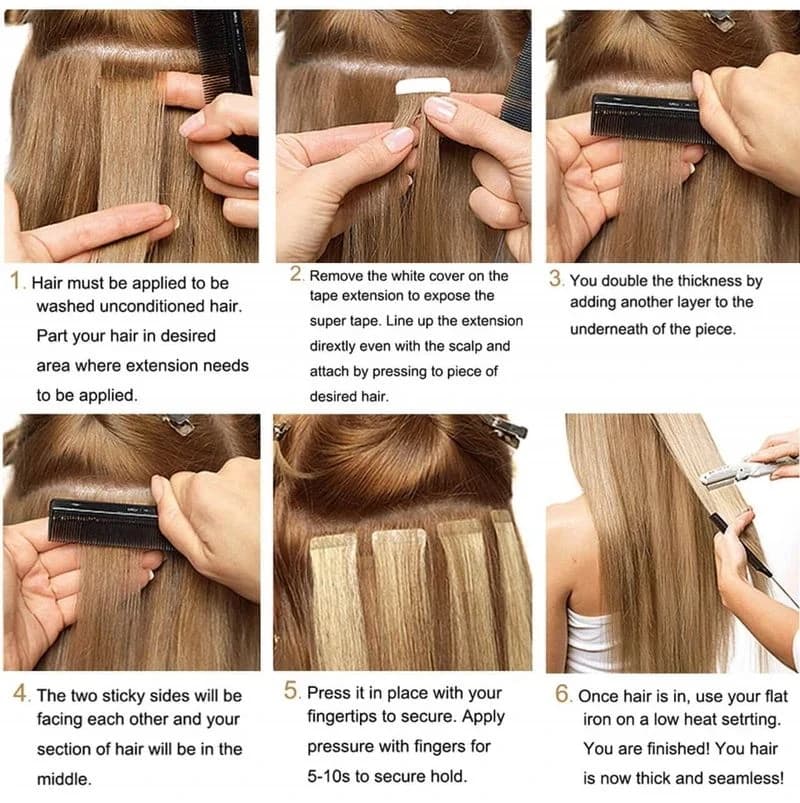
The supplied reference below shows a tape-in demonstration with embedded generic instructions. Its placement wording, pressure time and heat directions have not been validated for the selected DR product. Do not use the printed captions as DR fitting instructions.
A trained professional should use the actual system's requirements for preparation, sectioning, clearance, attachment and removal. A picture cannot establish the appropriate supporting hair, installed weight or compatibility of a heating step.
What to confirm before an appointment
Installation preparation should produce a written service plan rather than a decision based only on a product photograph.
- Identify the selected product, method, hair amount and attachment format.
- Discuss previous extension problems and known product sensitivities with the professional.
- Confirm the desired length, fullness and covering hair at the proposed positions.
- Obtain the product-specific preparation and fitting instructions.
- Agree home care, review dates, removal arrangements and how to report a concern.
Ask who will handle removal and what that service costs before paying for the installation. Budgeting for fitting without maintenance or removal can leave the client unable to follow the planned service. Our extension cost guide covers those separate charges.
Keep the starting condition and product identifiable
Where the client agrees, record the initial appearance of the proposed attachment areas and retain the product reference, installed count and date. Use comparable photographs at reviews to communicate changes; photographs support a discussion but do not diagnose a condition.
If a different shade, length, adhesive or strand specification is substituted, have the professional review the change before fitting. A familiar collection name does not establish that every variation uses an identical service plan.
Make a concern easy to investigate
When contacting the salon, provide the fitting date, product reference, location of the concern and when it began. Explain whether the change appeared during fitting, after a particular wash or product, or gradually during wear. Distinguish what you observed from a diagnosis you have not received.
Keep a list of the care and styling products used, along with any recent professional color work or adjustment. If you send photographs, use clear lighting and a comparable angle; do not pull on an uncomfortable attachment to expose it for a picture. Ask how promptly the salon can assess the fitting and whether you should also contact a clinician.
For a follow-up appointment, bring the written care instructions and any clinician's advice you want the stylist to consider. Record what was adjusted or removed and the next agreed step. This gives the professionals a useful history without assuming that a different product alone will resolve the original concern.
Care, maintenance and breaks between installations
Ask for the selected system's washing, detangling, drying and styling instructions in writing. Clarify which products can contact the attachment area and when professional checks are due. A routine that works for one tape, bond or clip-in product may not transfer unchanged to another.
The AAD's extension-care guidance recommends professional fitting and prompt adjustment of painful or overly tight styles. It also advises removing clip-ins before washing natural hair and giving hair breaks from extension styles. Its general advice suggests limiting continuous wear to two or three months before a break; a clinician may recommend avoiding extensions altogether for a particular concern.
Do not interpret a supplier's maximum advertised wear period as permission to continue through discomfort or visible changes. The next appointment should follow the individual's condition and professional plan, not an attempt to reach a marketing lifespan.
If you cannot attend maintenance while traveling, arrange support in advance or reconsider the timing. The tape-in maintenance guide explains product and service planning; it is not a substitute for assessment when symptoms appear.
What if your hair looks thinner after removal?
Reduced volume after taking out added hair does not, on its own, establish the cause of a change in natural hair. Equally, noticeable thinning should not be dismissed automatically as an adjustment to a less full hairstyle.
Ask the professional to inspect the hair and scalp after removal. Record whether the concern involves shortened hairs, a particular area, the hairline or a more general change. Provide the installation history and any symptoms, care products or color work that occurred during wear.
The British Association of Dermatologists explains that early traction-related loss can improve when pulling stops, while longstanding follicle damage may be permanent. Recovery cannot be promised from a photograph or assigned a universal timetable. Seek a dermatologist's diagnosis before using another installation to conceal unexplained thinning.
What supplier quality checks can establish
For salon procurement, product conformity remains useful. Confirm the sample's shade, texture, length, pack weight, piece count and attachment construction against customer requirements.
DR's confirmed quality-control process includes production-stage checks, weighing every pack and final sampling for weight, ruler-measured length, color, shedding and smoothness. A sampled nonconformity triggers full reinspection of the affected shipment. This factory testing and shipment inspection does not determine a wearer's suitable attachment load or establish a damage-free result.
Our documented US salon sampling experience began with a color ring and 300g across Genius Weft, Tape-in and Flat Tip products before later ordering. It is an example of product evaluation, not a clinical safety trial.
Approve the actual sample and product application plan separately. A well-presented supplied product and an appropriate installation are related decisions, and both need review.
Frequently asked questions
Do hair extensions always damage natural hair?
Damage is a risk, not an outcome that a product label can predict for every person. Repeated pulling, unsuitable fitting and problems during care or removal need attention. A professional assessment and ongoing review are important, but no method earns a universal damage-free guarantee.
Are tape-ins less damaging than rings or wefts?
A flat attachment alone cannot establish that ranking. Compare fitted weight, supporting hair, placement, selected products and removal requirements. The best method for a proposed service must be assessed as a complete arrangement.
Should new extensions hurt for a few days?
Pain or persistent pulling should be reported promptly rather than accepted as something to endure. Contact the stylist for professional assessment and adjustment or removal. Arrange medical assessment for scalp symptoms or hair loss as appropriate.
Can human hair or Remy labels prevent damage?
Those descriptions concern the supplied hair, not a guarantee about the natural hair supporting it. Attachment design, amount fitted, placement and service requirements still need assessment. Read the Remy material guide for the separate label questions.
Are clip-ins suitable for every person with thinning hair?
No. A removable panel still needs appropriate natural hair for support and coverage. With new or unexplained thinning, obtain a dermatologist's assessment before choosing an attached cosmetic solution. Then discuss an appropriate option with the relevant professional.
Will hair grow back after extension-related hair loss?
That depends on the diagnosis and whether follicles have sustained permanent damage. Stop exposing the area to ongoing pulling and seek a dermatologist's assessment. Do not rely on a brand, installation photograph or promised recovery date to answer that question.
Conclusion
Hair extensions can cause problems when the complete fitting and service plan is unsuitable. Choose through professional assessment, an exact product specification and realistic maintenance and removal arrangements. Report discomfort or visible changes promptly, and seek medical assessment for scalp symptoms or unexplained loss. Product quality supports selection; it cannot guarantee that every wearer can support an attached style.
HAIR EXTENSION SOURCING
Request a hair extension specification or quote.
Share your shade references, lengths, texture, quantities and preferred pack format. Fields marked with * are required.