
Introduction
An extension length chart helps you compare a stated product length before you choose a method, texture and quantity. Start with the measurement: 18 inches equals 45.72 cm, 20 inches equals 50.80 cm, and 22 inches equals 55.88 cm. Those numbers describe length, while the finished look also depends on placement, natural hair, styling and trimming.
Use this guide to shortlist lengths for a consultation or purchase enquiry. The chart compares labelled lengths. DR supplies an additional 1–1.5 inches of actual hair length beyond the label, measured root to tip after straightening. The product-specific notes below also distinguish stock from custom orders.
Hair extension length chart in inches and centimetres
The conversion is exact: multiply inches by 2.54 to obtain centimetres. The NIST conversion tables list this relationship. Rounded values are convenient for discussion, but retain the original inch specification on the quotation and order.
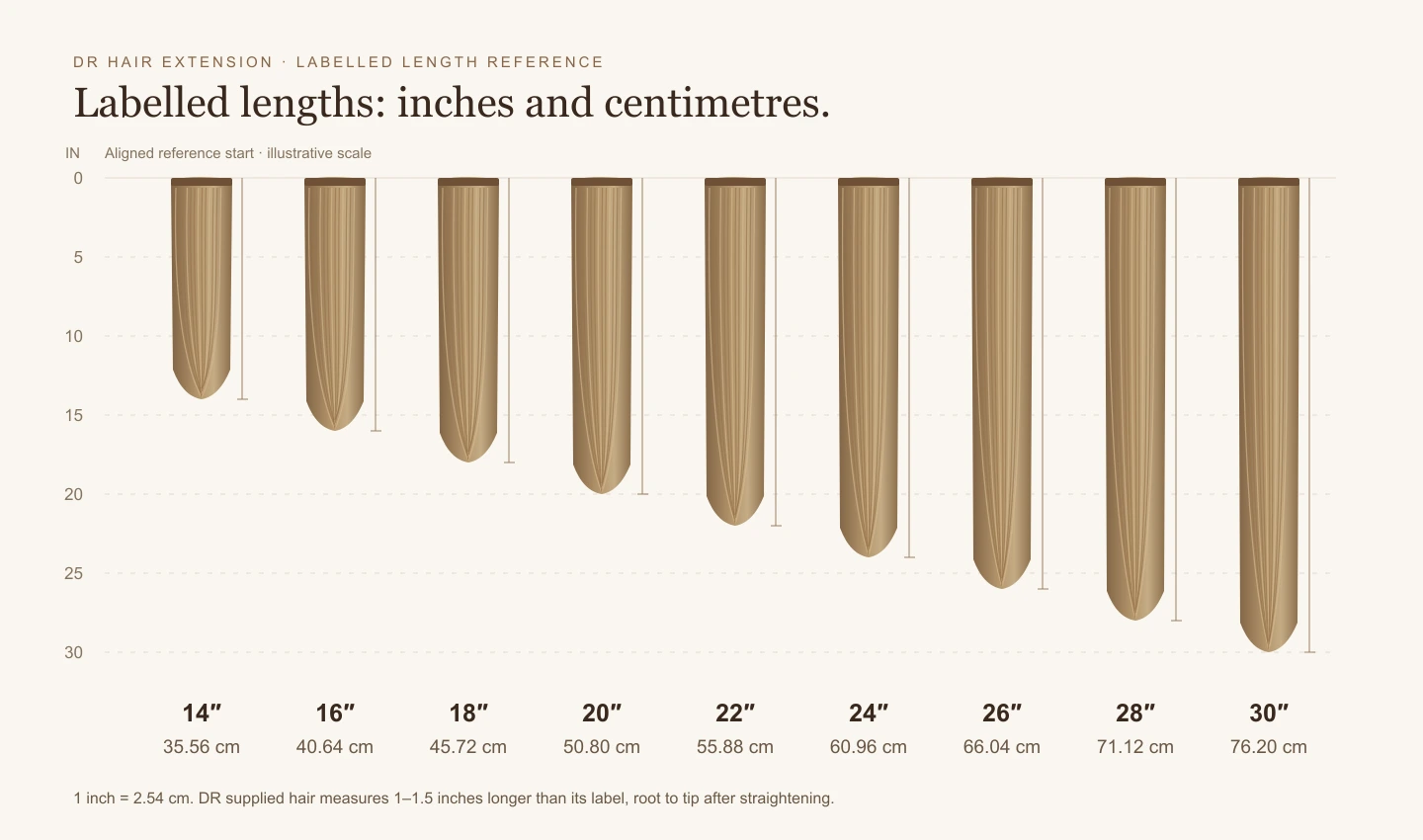
For a closer view of the illustration, open the full-size labelled-length chart.
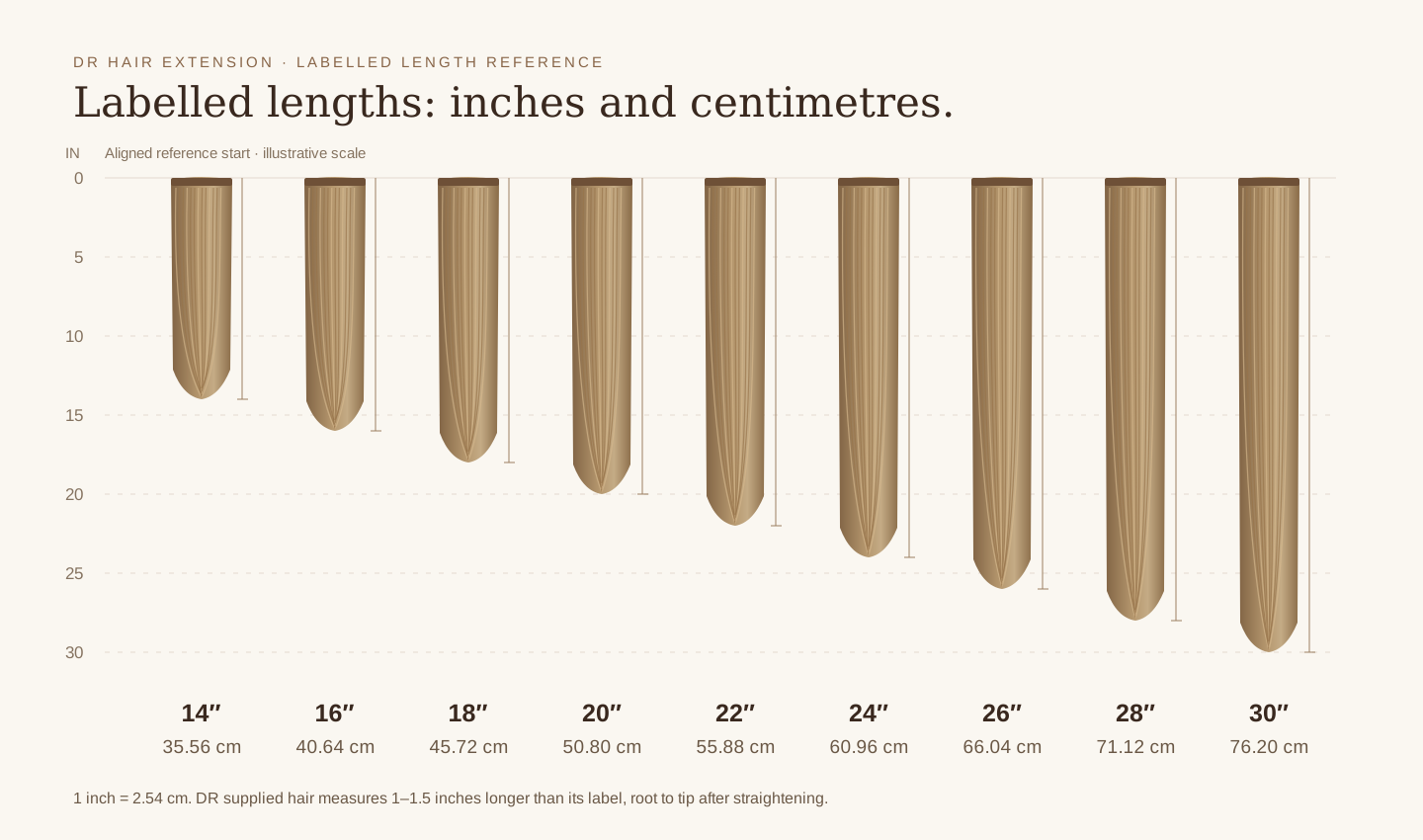
| Stated length | Exact centimetres | Rounded reference |
|---|---|---|
| 14 inches | 35.56 cm | About 36 cm |
| 16 inches | 40.64 cm | About 41 cm |
| 18 inches | 45.72 cm | About 46 cm |
| 20 inches | 50.80 cm | About 51 cm |
| 22 inches | 55.88 cm | About 56 cm |
| 24 inches | 60.96 cm | About 61 cm |
| 26 inches | 66.04 cm | About 66 cm |
| 28 inches | 71.12 cm | About 71 cm |
| 30 inches | 76.20 cm | About 76 cm |
A rounded centimetre value is not a separate manufactured size or an acceptance tolerance. For example, 20 inches and approximately 51 cm describe the same labelled size in this chart.
DR labelled length and actual supplied length
DR supplies actual hair length 1–1.5 inches longer than the labelled size. We measure from the hair root to the tip with wavy or curly hair straightened. Keep both the label and the supplied measurement clear when comparing samples or placing an order.
| DR labelled length | Actual supplied length before trimming | Metric equivalent of supplied length |
|---|---|---|
| 18 inches | 19–19.5 inches | 48.26–49.53 cm |
| 20 inches | 21–21.5 inches | 53.34–54.61 cm |
| 22 inches | 23–23.5 inches | 58.42–59.69 cm |
This extra length is separate from measurement tolerance. It does not predict the final length after fitting, curling or a blending cut. Record the labelled size on the order and confirm the actual supplied specification with the sample or quotation.
How to measure hair extensions consistently
Agree the starting point and endpoint
For DR products, measure from the hair root to the tip, straightening wavy or curly hair first. Ask for a photograph showing the root starting point on the selected weft, tape or individual strand. When comparing another supplier, confirm its measuring convention and additional-length policy rather than assuming it follows DR's specification.
Place the sample on a clean, flat surface beside a ruler or tape measure. Align the agreed starting point with zero, keep the ruler parallel to the length, and photograph the whole measurement. Avoid an angled photograph that hides the start or tips. A close-up of a label alone does not show the measured hair.
A length reference should not imply that every fibre reaches the same endpoint. Compare end fullness and drawn specification separately, especially when reviewing similarly labelled products from different suppliers.
Keep three measurements separate
Manufactured product length, visible vertical drop and finished length after cutting answer different questions. Write each one clearly in a consultation or specification. A wearer may request a particular finished look, while the stylist orders a different starting length to allow for the planned placement and blending cut.
For shipment inspection, compare the supplied sample with the agreed product-measurement method. For salon planning, assess the intended attachment position and natural fall. Keeping these records separate makes a repeat order easier to reproduce.
Why the same length can look different
Placement and body proportions
An extension starts at its attachment position rather than at a universal point on the head. Rows or strands placed at different heights can finish at different levels even when their supplied lengths match. A crown-based wig chart therefore cannot automatically predict the result of a lower extension row.
Height is only part of the picture. Neck length, torso proportions, shoulder position and the direction in which the hair falls also matter. Body landmarks such as the bust or waist are useful discussion references, but they are not reliable manufacturing specifications.
During installation preparation, ask the stylist to mark the proposed fitting area and hold a flexible measuring tape in the direction of the intended fall. Compare that preview with the desired style. Recheck from the back and sides rather than relying on one front-view photograph.
Straight, wavy and curly texture
Waves and curls change visible drop because the hair follows a curved path. DR measures them after straightening. Their natural drop depends on the actual pattern and styling; there is no single number of inches to add for every curly product. Compare like-for-like texture samples.
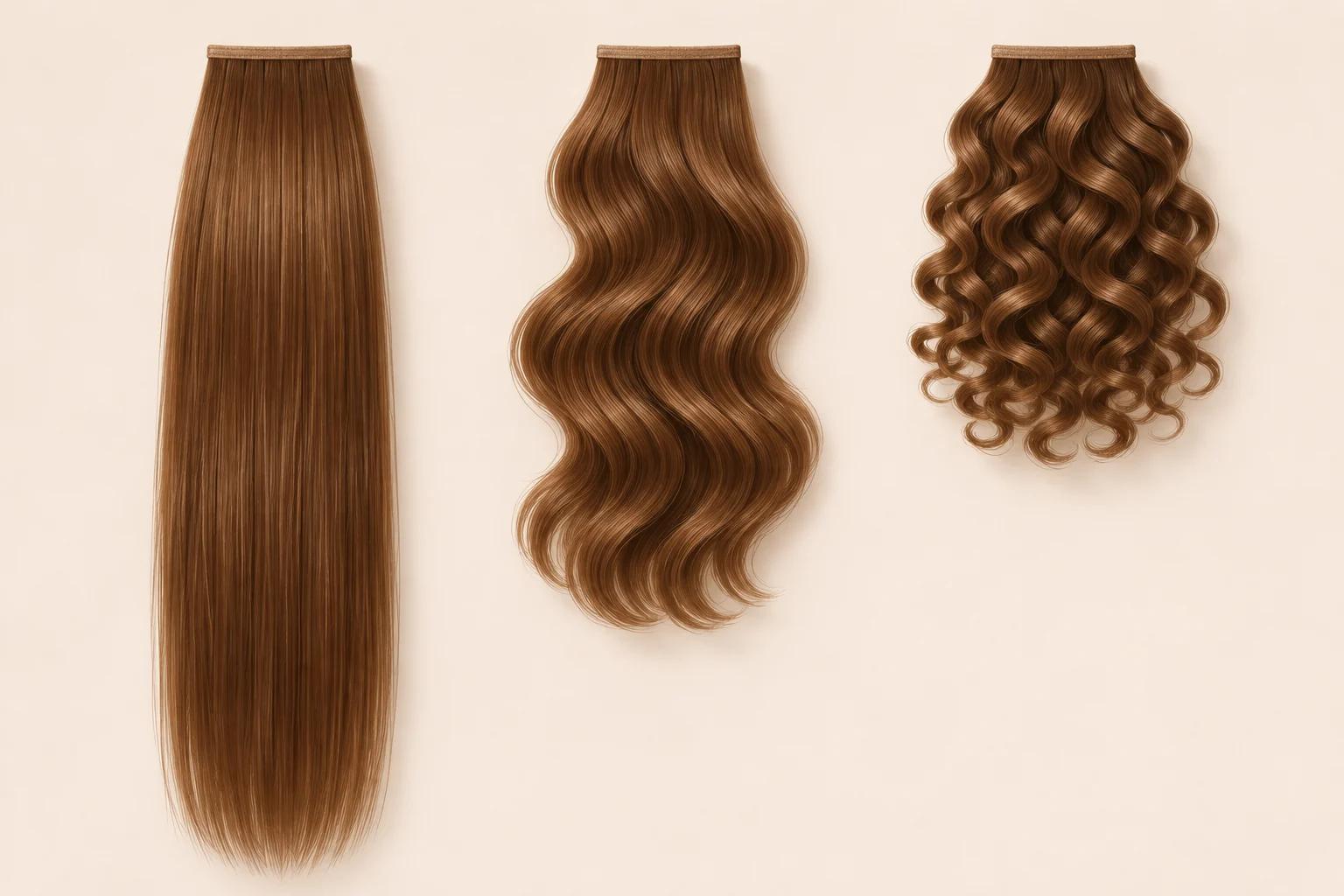
Cliphair's published length guide uses a model-based comparison to help explain length choices. Treat any brand's model images as examples of a specific presentation. Your own texture sample and fitting plan remain the more useful references for an individual order.
Choosing between 18, 20 and 22 inch extensions
Moving from 18 to 20 inches adds 5.08 cm to the stated product length. Moving from 20 to 22 inches adds another 5.08 cm. Across the full 18-to-22-inch comparison, the difference is 10.16 cm. These are dimensional differences before placement, styling or trimming.
Choose the length around the intended result. Adding fullness close to the existing haircut is a different project from extending a short, blunt perimeter. Ask the stylist whether the proposed length can blend through the natural ends, where face-framing pieces should finish, and how much cutting is planned.
For a buyer comparing adjacent sizes, use samples in the same method, texture and end-fullness specification. Otherwise, a difference in curl pattern or density may dominate the visual comparison. Record the chosen size after sample approval, rather than switching lengths because a second supplier uses a different model photograph.
Shorter changes and extra-long selections
The 14–16-inch references can help with a more modest length change or fullness near an existing style. They are not automatically the correct choice for every shorter or fine-haired client. Check natural-hair coverage and the intended attachment concealment during the consultation.
For 24–30-inch selections, discuss blending, end fullness, styling time and practical aftercare before ordering. Confirm that the specific DR construction offers that size. A diagram extending to 30 inches does not extend the product range of a 14–26-inch clip-in or a 14–28-inch Hand-Tied Weft.
Match the chart to actual DR product options
The following references come from the current DR catalog. They distinguish listed stock lengths from made-to-order ranges. Availability still needs confirmation for the selected colour, quantity and specification.
| DR construction | Listed length reference | Ordering point |
|---|---|---|
| Genius Weft | Stock lengths: 18, 20 and 22 inches | Other lengths by custom request |
| K-tip / Flat Tip Hair | Stock lengths: 18, 20 and 22 inches | Confirm the strand and bond specification |
| Regular Tape-in Hair | Stock length: 22 inches | Other lengths by custom request |
| Butterfly Weft | Stock length: 22 inches | Other lengths by custom request |
| Nano Ring Hair | 14–30 inches; 22-inch stock | Other lengths made to order |
| Hand-Tied Weft | 14–28 inches | Made to order |
| Flat Weft, Volume Weft and Machine Weft | 14–30 inches | Made to order |
| Invisible Tape Hair and Tape Weft | 14–30 inches | Made to order; method-specific minimums apply |
| Clip-in Hair and PU Clip-in Hair | 14–26 inches | Made to order; confirm the set layout |
| Feather Hair | 14–30 inches | Made to order |
Do not infer a full stock matrix from these ranges. A listed 22-inch stock method does not establish that every Balayage shade or requested pack quantity is available. Check colour and construction together; the colour chart supports matching, while the quotation confirms supply.
Extra long hair extensions wholesale
Already buying longer lengths for a salon or hair brand? Start with the labelled length, attachment method and approved end profile you need to continue. “Extra long” is a buying description, so put the actual inch length and measuring condition on the quotation.
For 24–30 inch requests, use the product-specific ranges above. Flat, Machine, Volume, Invisible Tape and Tape Weft list made-to-order ranges through 30 inches. Hand-Tied lists lengths through 28 inches; Clip-in and PU Clip-in list lengths through 26 inches. Stock references for other methods do not establish that a longer requested combination is ready to dispatch. Confirm the chosen method, shade and quantity with DR.
| Compare before changing suppliers | Record for the sample and quotation |
|---|---|
| Supplied and finished length | Labelled inch length, measurement photograph, texture and planned finishing cut |
| Fullness at that length | Current retained sample or end-profile reference, with the same pack weight and piece layout |
| Repeat-order configuration | Method, physical shade reference, net hair weight, piece or strand count, and quantity per length |
| US delivery planning | Production, packaging readiness, dispatch, freight and transit confirmed separately against the next order date |
Review a representative sample at the actual length you plan to reorder. A shorter approved sample does not establish the end profile of a longer version. Keep the measurement and end-fullness references together, and use the double drawn wholesale comparison to document your approval target.
For a length outside the published product ranges, ask DR to confirm feasibility before planning an order. This chart does not establish a stock or custom offer beyond those ranges.
Length, grams and end fullness are different choices
Length alone does not determine how much extension hair a client should wear. A 100g pack remains a purchasing unit, while the suitable fitted amount depends on the natural hair, placement plan and desired result. Avoid a universal rule such as one pack for short hair and two packs for long hair.
At a fixed weight, a longer specification distributes the hair over more length. Compare the actual sample for density through the ends, as well as base or strand construction. Single drawn and double drawn hair describe another part of that comparison; they do not replace a length measurement.
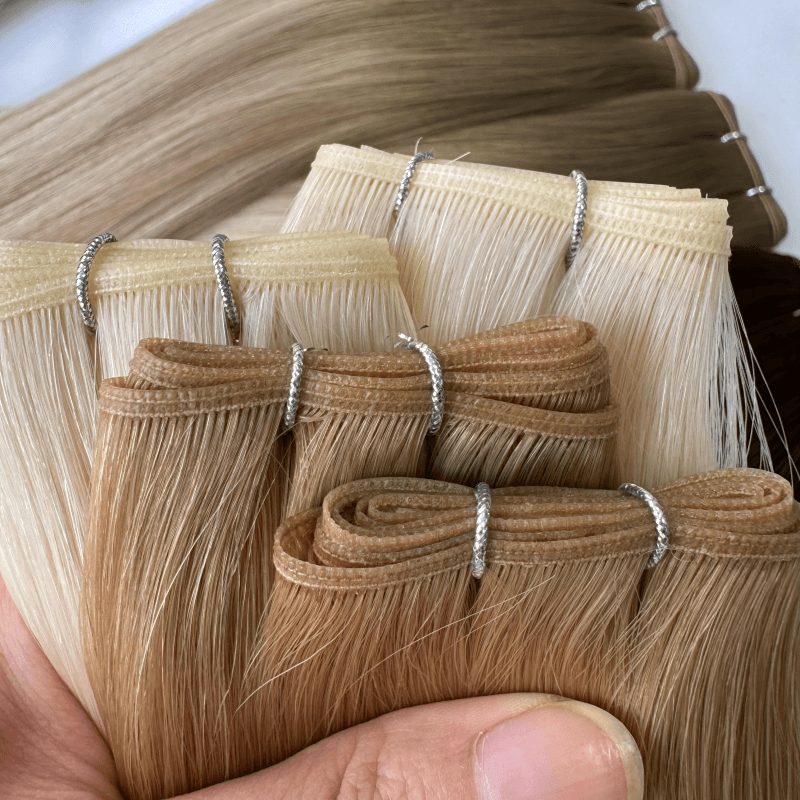
DR regular Tape-in Hair, for example, uses a standard 100g pack of 40 individual tabs. That format does not establish a full-head prescription. Hand-Tied Weft uses a standard 100g pack with 5 or 6 wefts, or a custom count. For the quantity calculations, use our grams, pieces and packs guide.
From a sample to a repeatable wholesale order
Use salon application to define the specification
In our published US salon customer story, an independent stylist began with a physical colour ring and 300g of samples across three methods. She evaluated the hair in salon applications before developing repeat orders and her own collection. She then used the colours, lengths and methods requested by clients to guide replenishment.
That experience supports a practical buying sequence: compare the physical sample, assess product application, and record the approved specification. For a length-focused order, keep the measurement photograph, chosen texture, end-fullness reference and planned finished result together.
Connect factory checks with the order brief
DR carries out quality checks at each production stage and weighs each pack against the agreed pack weight. Final pre-shipment inspection is carried out by sampling, including ruler measurement of sampled hair against the agreed length specification. Other sampling checks include colour under inspection lighting, shedding and smoothness. If sampling identifies a nonconformity, the affected shipment is fully re-inspected.
When discussing factory testing or shipment inspection, ask which checks apply to your customer requirements and how a discrepancy will be documented. Agree any measurement tolerance before production. This guide does not publish a universal DR tolerance or turn chart rounding into an acceptance rule. See the pre-shipment inspection explanation for the confirmed process.
Before requesting a quotation, record the method, inch length, shade, texture, hair option, pack format, quantity by specification, destination and required date. Include any planned trim and sample requirements. Confirm production, dispatch and international transit separately so the salon schedule is based on the actual order.
Frequently asked questions
What should a wholesale buyer compare before ordering extra long extensions?
Compare the exact labelled length, measurement condition, texture, end-fullness reference, net pack weight and piece or strand layout. Review a sample at the intended length and confirm the selected method's range, quantities and production timing. Stock, packaging readiness and US-bound shipping are separate confirmations; the length chart alone does not establish availability.
How long are 18 inch hair extensions in centimetres?
Eighteen inches equals 45.72 cm, or approximately 46 cm. The number describes the stated product length. Where it finishes on a wearer depends on the attachment position, body proportions, texture and styling.
Should I choose 20 or 22 inch extensions?
The stated difference is 2 inches, or 5.08 cm. Compare samples in the same texture and construction, then review the planned fitting position and blending cut with a stylist. Desired finished length and supplied product length may differ.
Why do curly extensions look shorter?
A curl follows a curved path rather than hanging in a straight line. Visible drop depends on the actual curl pattern and styling. Agree the measuring condition and compare a physical sample instead of applying a fixed shrinkage allowance to every texture.
How does DR measure hair extension length?
DR measures from the hair root to the tip with wavy or curly hair straightened. The actual supplied hair is 1–1.5 inches longer than the labelled size. Keep a measurement photograph with the approved specification and compare both labelled and supplied lengths when evaluating samples.
Are all lengths in this chart available from stock?
No. The conversion chart is independent of stock. Genius Weft and K-tip list 18, 20 and 22-inch stock options; regular Tape-in, Butterfly Weft and Nano Ring list 22-inch stock. Other lengths and methods follow their individual custom-order terms. Confirm the exact colour and quantity.
Does a longer length mean I should install more grams?
There is no automatic fitted-weight formula based only on length. A stylist should assess the natural hair, coverage, method and intended result. Compare pack weight, piece count and end fullness separately before converting an installation plan into an order.
Can hair extensions be trimmed after fitting?
A stylist can plan a blending cut through the hair lengths, allowing for the finished result. Cutting the hair ends is different from cutting an attachment seam. For DR Hand-Tied Weft, keep the top seam intact because cutting it can cause shedding.
What information should I send for a length quotation?
Send the method, inch length, texture, shade, hair option, pack format and quantity per combination, plus destination and required date. Include sample needs and any measurement or end-fullness reference. DR will confirm the available specification and order terms.
Conclusion
Use a hair extension length chart to compare dimensions, then use a physical sample and fitting plan to choose the finished result. Keep inches and centimetres consistent, treat texture and placement as separate variables, and confirm the selected product's stock or custom range. A clear length specification helps the stylist, buyer and supplier work toward the same approved order.