
BUYING GUIDE
Wholesale Tape-in Hair Extensions: A Salon Buying Guide
Compare wholesale tape-in hair extensions: 100g packs, tab counts, MOQ, color matching, paid samples and delivery for salon orders.
Introduction
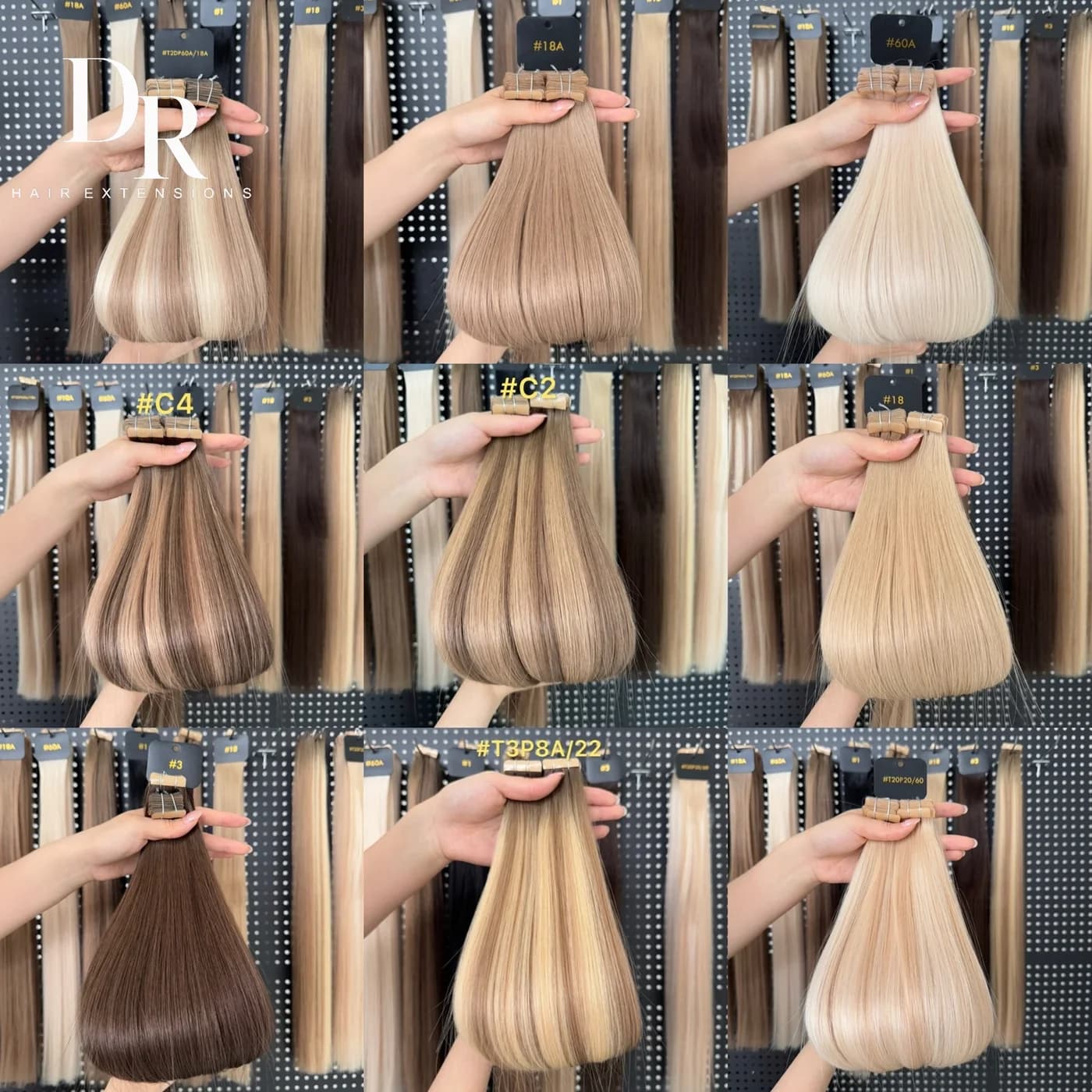
When buying wholesale tape-in hair extensions, compare the complete pack specification before comparing prices. Record total hair weight, individual tab count, tape dimensions, shade, length and order quantity together. Approve representative samples, then confirm stock or custom production and delivery costs for the exact selection.
For DR's regular Tape-in Hair, the standard pack is 100g with 40 individual tabs and 4 × 0.8cm attachments. The minimum hair order is 100g per color and length. The current stock range covers more than 40 colors at 22 inches; confirm the availability of your chosen shades. Paid samples use the same hair pricing as wholesale orders, with delivery quoted for the destination.
This guide helps salons turn those details into a practical sample order and opening assortment. DR Hair Extension publishes it as a manufacturer and wholesale supplier. Our product examples describe the current collection; your quotation should confirm the approved specification, quantity and schedule.
Read the pack specification before comparing prices
A quote for “40 pieces” is incomplete unless the supplier explains what counts as one piece. An individual adhesive tab, a two-tab sandwich pair and a retail pack are different quantities. Ask for the count in writing and compare the same units across suppliers.
| DR regular Tape-in specification | Standard configuration | What the buyer should confirm |
|---|---|---|
| Total hair weight | 100g per pack | Net hair weight and any custom pack format |
| Individual tabs | 40 per pack | Whether the quote counts tabs or pairs |
| Average hair weight per tab | Approximately 2.5g | The agreed count and total pack weight |
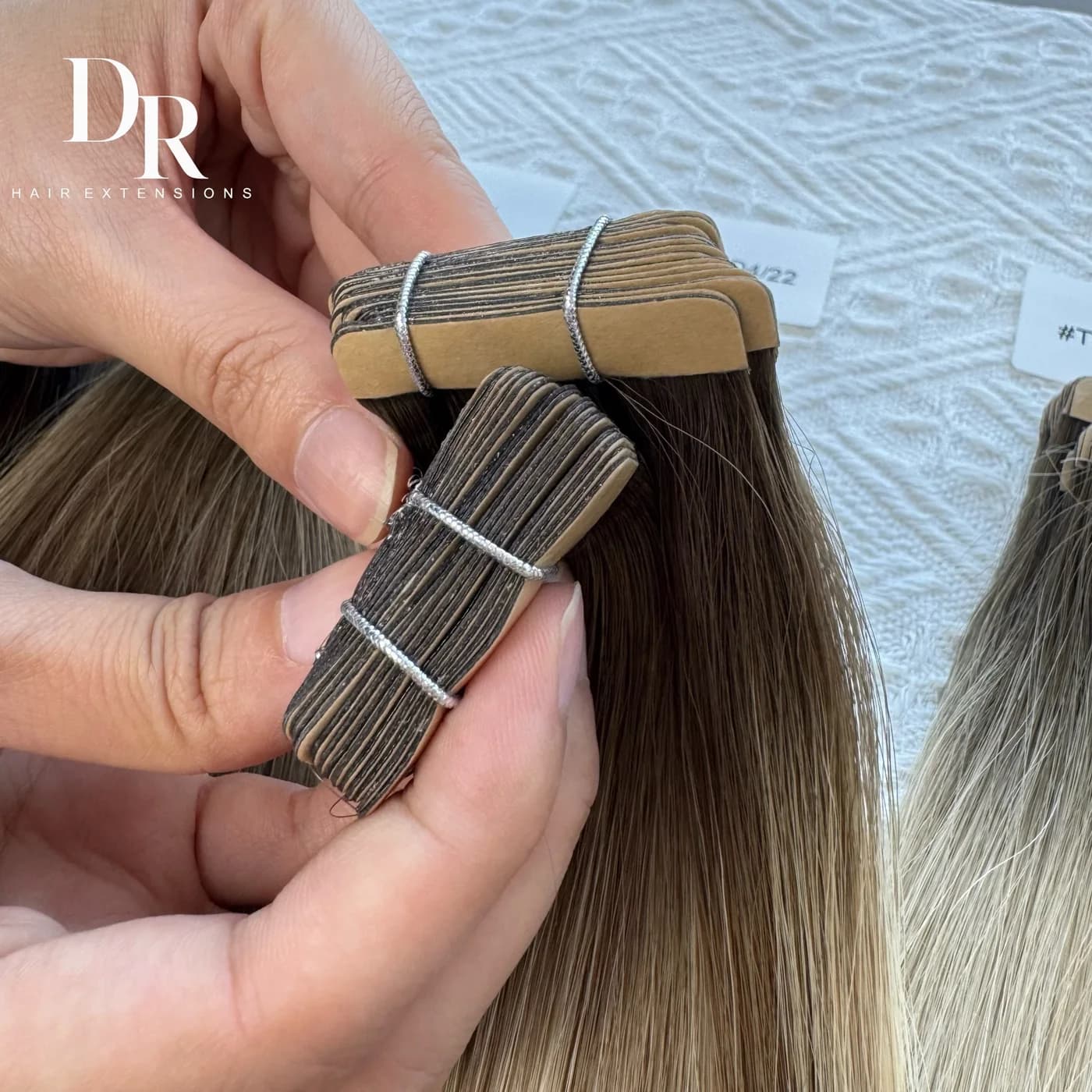
| Tape dimensions | 4 × 0.8cm | Compatibility with the intended professional method |
| Stock selection | 22 inches, 40+ colors | Availability of the selected shade and quantity |
| Minimum hair order | 100g per color and length | Separate terms for packaging or other customization |
With a two-tab sandwich method, 40 individual tabs form 20 pairs. At the standard configuration, each pair represents approximately 5g of hair. This arithmetic describes pack contents; it does not prescribe how many pairs a stylist should fit. Client hair, the desired result and professional placement determine the installation plan.
Use the regular Tape-in Hair product page as your specification reference. If you request a different pack weight, piece count or tape size, ask the supplier to restate all related quantities. A custom count should never leave you guessing whether the pack still contains the originally quoted hair weight.
Choose regular or Invisible Tape Hair deliberately
Product names such as “invisible” and “seamless” do not provide a complete construction specification. Compare the attachment area, hair distribution, shade presentation and the professional application guidance for the actual sample. Ask which DR product the quotation covers instead of assuming every tape-in option has the same stock policy.
DR's regular Tape-in collection has the standard 100g, 40-tab format described above and ready stock at 22 inches. Invisible Tape Hair is made to order, with no ready stock. Its configuration, minimum order and production arrangements should be confirmed on its own quotation. Regular Tape-in stock terms should not be transferred to that product.
For a salon starting a collection, define the service and attachment format first. A sample lets your stylist review the actual construction alongside handling and color. If the sample does not suit the intended method, resolve the specification before developing branded packaging or booking an installation around it.
Plan colors and minimum orders as separate combinations
DR's 100g minimum applies per color and length, rather than to an unrestricted mix of shades. Three colors at 22 inches, with one standard pack of each, make a 300g hair order containing 120 individual tabs. This is an inventory example, not an installation recommendation or a requirement to buy three shades.
Start with colors supported by real consultations or existing sales. Record which packs are intended for booked clients and which remain available for future appointments. A pack already allocated to a consultation should not also be counted as replenishment stock for another client.
Use the hair extension color chart and matching guide to identify shade references. Then confirm physical samples or a color ring for the tones central to your assortment. Screen images help begin a conversation, but lighting, photography and display settings can change how a color appears.
Record more than a blonde or brown shade name
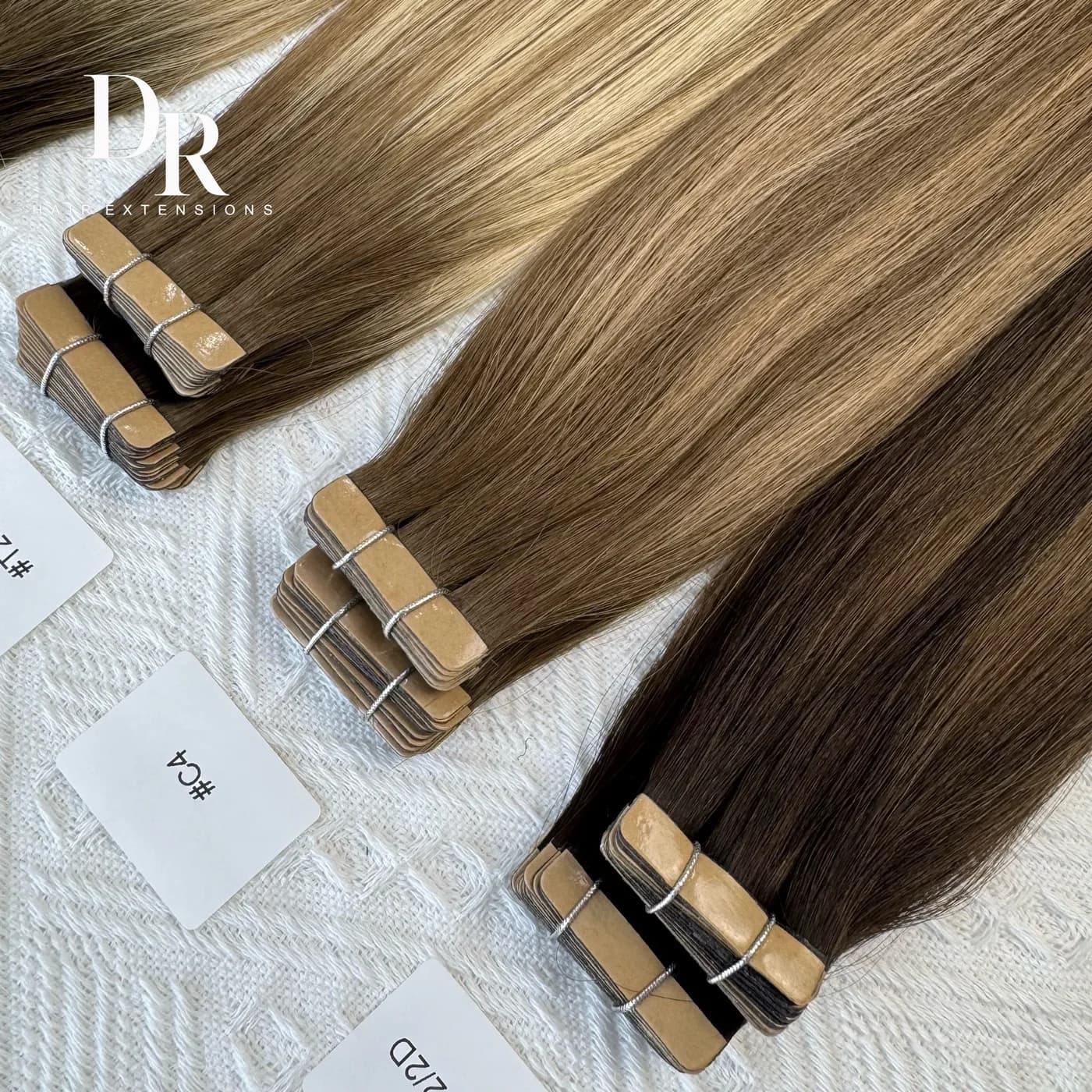
For rooted or blended shades, specify root depth, transition position, mid-length tone and ends. Keep the agreed reference number, a photograph taken under consistent conditions and the supplier's confirmation together. If a custom shade is approved, retain the physical reference for subsequent orders.
The stock range is not a live promise that every listed color is available in every quantity. Confirm the chosen shade, 22-inch length and number of packs before scheduling a time-sensitive appointment. Other lengths and custom colors require their own availability and production confirmation.
Keep texture and hair options on the order sheet
DR offers Virgin Hair and Remy Hair options, along with straight, body wave, curly and natural wave textures; custom curl patterns can be discussed from reference photographs. Ask which hair option and processing description apply to your sample. A product label alone does not establish an exact processing history, end fullness or guaranteed lifespan.
Evaluate a sample through a documented salon workflow
Choose samples that represent the products you expect to reorder. A sample assessment is more useful when it answers specific questions: Does the shade match the intended reference? Is the tab construction suitable for your method? Does the hair behave acceptably under your professional care routine?
The following is a suggested buyer evaluation process, not a statement that DR has completed a controlled wear trial for every configuration. Agree with the supplier which handling or application steps are permitted before assessing an issue under the applicable after-sales terms.
Check the sample before application
Record the supplier, sample reference, shade, length, texture, hair option, total weight and individual tab count. Compare the contents with the quotation. Ask how length and weight are measured if your checks appear different, and resolve the discrepancy before using or altering the sample.
Inspect color consistency, end fullness, smoothness and visible attachment construction. Photograph the sample under consistent lighting. Product photographs illustrate appearance, while measurements and an agreed physical reference support approval. Avoid setting a tolerance after the order arrives; agree on relevant acceptance criteria beforehand.
Let a trained stylist assess application and maintenance
Request the preparation, installation, removal and replacement-tape guidance for the chosen product. Have a trained professional assess attachment compatibility and suitability for the intended client. Do not assume that a preferred tape or care product is approved for every construction.
During a salon assessment, record the washing, brushing, drying and styling routine used. Note handling, tangling, shedding, color appearance and the condition of the attachment. Consistent notes make a comparison more useful than a general impression such as “soft on arrival.” A single sample cannot establish a universal wear period.
Finish with an approval decision
Mark each sample as approved, requiring a defined adjustment, or unsuitable for the planned use. Write down the reason and retain an approved reference where practical. If you change the shade, tape dimensions or texture, confirm whether another sample is needed before placing the larger order.
DR's published US salon sampling journey describes a stylist starting with a color ring and 300g across three formats, including tape-in. She reviewed the hair through salon use before reordering and developing branded presentation. It is one anonymized experience, rather than a promised commercial result or an independent product comparison.
Compare hair pricing and delivery on the same basis
DR sample hair uses the same pricing as wholesale hair. The amount payable still depends on the selected hair, quantity, customization and delivery arrangement. Ask for a written sample quotation rather than assuming a fixed sample-kit price, a discount or free delivery.
When comparing suppliers, request the same shade, length, hair option, texture, pack weight and tab format. Separate hair charges, packaging and delivery, and ask which destination charges are included. Comparing only the number of packs can be misleading when pack contents differ.
For your own purchasing sheet, divide the quoted hair-only total by the number of standard 100g packs to compare hair cost per pack. You can also calculate cost per individual tab or two-tab pair, provided every quotation uses the same configuration. Record consumables, professional labor and replenishment separately when planning the salon service.
Use a quotation brief that can become an order record
An example inquiry is: “Please quote regular Tape-in Hair in the attached shade references at 22 inches, straight texture, standard 100g packs with 40 individual tabs and 4 × 0.8cm attachments. Confirm the hair option, quantity per shade, sample charge, stock availability, dispatch arrangement and delivery cost to our country.”
Attach the quantity breakdown and ask the supplier to identify unavailable items or proposed substitutions before payment. Keep the approved quotation, sample reference and packing information together. That gives both parties a clear record when discussing a reorder or a discrepancy.
Separate stock dispatch, custom production and transit
Confirmed in-stock regular Tape-in orders can dispatch the same day, subject to the availability and arrangements confirmed for the order. This is a dispatch condition, not a same-day delivery promise. Confirm the actual collection or dispatch arrangement when planning an appointment.
Custom regular Tape-in orders normally dispatch in 5–10 working days. The selected specification and quantity must be confirmed before relying on that estimate. A requested custom length should not be treated as ready stock simply because the corresponding shade exists at 22 inches.
Estimated delivery is around 2–4 working days after dispatch. Destination, courier service and customs clearance can affect transit, so keep production and shipping as separate entries on your purchasing calendar. Ask for the schedule that applies to your selection before announcing a launch date or confirming client bookings.
For repeat orders, track the shade, length and pack configuration being used most often. Compare the remaining stock with committed appointments and the latest confirmed replenishment schedule. When a new shipment arrives, review labels and shades against the approved reference before mixing it with existing inventory.
Check the delivered order before allocating appointments
Count the received packs against the packing list and check their product, shade and length labels. Compare the supplied configuration with the approved order, including any agreed custom tab size or piece count. Keep different shipments identifiable while you make this comparison, particularly when replenishing similar rooted or blended shades.
If a pack appears different from the approved reference, retain its packaging and take clear photographs before changing or using the hair. Send the order reference, affected quantity and a specific description to the supplier. Follow the reporting arrangements and after-sales terms agreed for that order rather than assuming a universal deadline or remedy.
Keep a simple receipt record containing the delivery date, quantity, shade references and the person who checked the shipment. This gives your salon a practical starting point if an appointment allocation, stock count or later reorder needs to be traced.
Build private-label packaging around an approved product
Once the hair specification is approved, use the private-label service to discuss boxes, bags, labels, instruction cards, hang tags, hangers or accessories. Provide your logo and completed design, or ask for help with logo placement and packaging layout.
Packaging quantities are confirmed independently of the hair order. The 100g hair minimum does not automatically define a printed-box minimum. Ask separately about packaging sample charges, preparation time, artwork approval and the schedule for the selected format.
Check that the packaging identifies the correct product, shade, length, net hair weight and tab count. Confirm any care or application wording against the selected product's guidance before printing. Keep the approved artwork version with the product specification so a packaging reorder does not introduce inconsistent information.
Ask about quality control as part of the same approval. DR's pre-shipment inspection process includes production-stage checks and individual pack weighing; final inspection uses sampling for weight, measured length, color, shedding and smoothness. A sampled nonconformity triggers full re-inspection of the affected shipment. Confirm any additional acceptance criteria or records your order requires.
Frequently asked questions
What is the MOQ for wholesale Tape-in Hair?
DR's regular Tape-in Hair minimum is 100g per color and length for stock and custom hair orders. Standard packs contain 40 individual tabs. Confirm your sample selection and ask separately about quantities for branded packaging or a different tape-in construction.
Does a 40-piece pack contain 40 sandwich pairs?
No. In DR's standard configuration, 40 pieces means 40 individual tabs. They form 20 pairs when used in a two-tab sandwich method. The pack contains 100g of hair in total. A trained stylist determines the appropriate application amount and placement.
Can I buy samples before a bulk order?
Yes. Small sample orders are available, with sample hair priced on the same basis as wholesale hair. Share your shades, lengths, texture, product format and destination to confirm the sample arrangement and delivery charge. Approve representative samples before expanding the assortment.
Which colors and lengths are ready stock?
Regular Tape-in Hair has more than 40 stock colors at 22 inches. Confirm the selected shades and quantities when requesting a quote. Other lengths can be customized. Invisible Tape Hair is a separate made-to-order product with no ready stock.
Can tape-in extensions be reused?
DR's regular Tape-in Hair can be considered for reuse with replacement tape and a professional assessment of the hair's condition. Obtain the cleaning, removal and replacement guidance for the selected construction. The number of reapplications depends on condition, care and the professional assessment rather than a fixed reuse promise.
How long will my order take?
Confirmed stock orders can have same-day dispatch arrangements. Custom regular Tape-in orders normally dispatch in 5–10 working days. Estimated delivery is around 2–4 working days after dispatch, depending on destination, courier and customs. Confirm all stages for your order and treat custom packaging as a separate schedule.
Conclusion
A useful wholesale tape-in purchase begins with matching units: total pack weight, individual tabs, tape dimensions and quantities per shade and length. Use physical color references, approve samples through a documented professional workflow and obtain a quotation that separates hair, packaging and delivery. Those records support both the opening assortment and consistent replenishment.
TAPE-IN HAIR SOURCING
Request a Tape-in Hair specification or quote.
Share your shade references, lengths, texture, quantities and preferred pack format. Fields marked with * are required.