
BUYING GUIDE
Private Label Hair Extensions: A B2B Launch Checklist from MOQ to Packaging
Plan a private-label hair extensions launch with a practical checklist for MOQ, samples, product selection, colour, packaging, production approval and shipment.
Introduction
Private-label hair extensions are not created by putting a logo on a box at the end of production. A successful launch connects a product decision, buyer segment, shade plan, pack format, packaging proof and reordering process. The first collection does not need every construction, colour and length. It needs a focused assortment that can be explained, sampled, inspected and replenished with confidence.
This guide is for salon owners, online sellers, distributors and new hair brands that want to source a private-label collection from an overseas supplier. It explains the decisions that should happen before production, the questions that shape MOQ discussions and the checkpoints that protect your brand presentation.
**Quick answer:** Start a private-label hair-extension collection with a narrow product range, a written specification, a representative sample, approved packaging proof and a shipment-inspection plan. MOQ is only one decision; it should be considered alongside colour variety, length mix, packaging complexity and reorder demand.
Define the brand promise before choosing SKUs
Private label works best when a buyer can explain the range in one sentence. For example: “A professional low-profile weft collection for salon colour matching,” or “A ready-to-ship tape-in range for online customers who need natural shades.” This statement is not advertising copy yet. It is a sourcing filter.
Use it to decide:
- who will buy the hair and where they will buy it;
- whether the first range is salon-led, wholesale-led or direct-to-consumer;
- which product construction solves a real customer requirement;
- how many colours and lengths are practical for the first order;
- what level of packaging is needed to make the product recognisable and usable;
- what questions your customer should be able to answer from the pack and product page.
A broad collection can look impressive in a catalogue but be difficult to launch. Every added texture, colour, length and construction creates another stock, quality and packaging decision. A smaller range with clear product information often creates a better first buying experience.
Select a first assortment that can be controlled
Start with one hero construction
Choose the product format that fits the intended application. A salon program may begin with a genius/flat weft or another professional system. An e-commerce collection may begin with an easy-to-understand tape-in or clip-in offer. The right first product is not necessarily the product with the most search volume; it is the product your team can describe, support and replenish.
For the first production run, define the exact construction. Do not ask only for “premium hair.” State the weft, tape tab, tip, clip or cap format; the net-weight presentation; the length range; the texture; and the intended installation or end-use context.
Limit the colour and length matrix
Colour variety can become expensive and difficult to manage quickly. Start with a commercially sensible set based on your customer requirements: core natural shades, selected dimensional shades or a targeted colour family. Confirm how each shade will be represented in images, labels and any physical colour ring.
Length planning matters just as much. Longer lengths can change pack presentation, cost, lead time and how full the ends appear. Instead of automatically listing every length, select the lengths you can clearly position and stock. Record the net weight per pack and do not assume that product density is identical between lengths or suppliers.
Decide what is custom and what is standard
Private label does not mean every component must be custom. A practical first launch may use a standard product construction and pack format with customised logo labels, outer boxes, insert cards and colour stickers. More complex customisation—such as bespoke shades, custom moulds or unique pack structures—can be introduced after the core product is stable.
This distinction makes MOQ discussions more productive. A supplier can normally quote more clearly when they know which parts are standard stock and which parts need a separate production or print run.
Understand MOQ without treating it as a single number
MOQ may apply at more than one level:
- product construction or hair type;
- colour or length SKU;
- packaging item, label or printed insert;
- logo application or finishing process;
- total order value or production batch.
Ask the supplier to separate these requirements. “What is your MOQ?” is less helpful than: “What is the MOQ per colour and length for this weft? What is the MOQ for a custom box? Can we use a standard box with a branded label for the first order? Which quantity changes the packaging price?”
This allows a buyer to compare launch options rather than force an unsuitable quantity. A flexible launch may combine a lower product MOQ with a simpler packaging approach. A larger branded launch may justify printed boxes and inserts. The right choice depends on forecasted demand and the cost of carrying slow-moving stock.
Create a private-label specification pack
Your specification pack is the bridge between brand design and production. It should include the product description, SKU matrix, colour naming, packaging artwork and approval steps.
Product specification
Record product type, construction, hair texture, length, net weight, colour reference, pack contents and intended customer. Include what the supplier should confirm during factory testing or finished-product checks. If a term is important to your customer, define it rather than relying on a loose market label.
Packaging specification
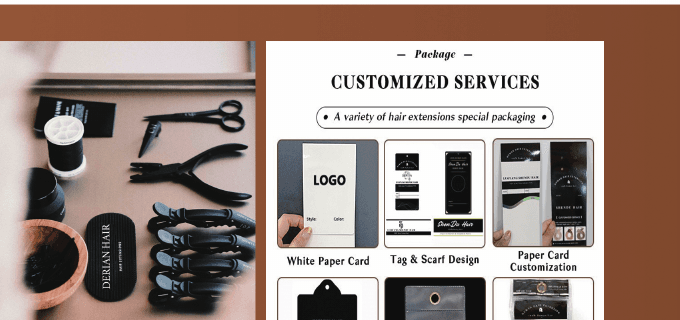
Provide editable logo artwork in the requested format, brand colour values, packaging dimensions where known, copy, label placement, insert content and barcode or SKU requirements. A packaging proof should be reviewed for spelling, colour, product matching and the correct version number before printing.
Customer-facing information
Decide what information belongs on the pack: product name, texture, length, colour, net weight, care direction, batch or SKU code and safety or legal information required for your market. Do not place claims on packaging that you cannot support. Clear, accurate product information builds more trust than exaggerated promises.
Sample approval is where private label becomes real
An approved product sample and approved packaging proof are two separate decisions. Where possible, review both together before bulk production. The finished presentation should show that the product, shade label, insert and outer package work as a system.
During sample review, check:
- product construction and appearance;
- texture, colour and length representation;
- net-weight and pack presentation;
- logo placement, print quality and colour;
- label accuracy and barcode/SKU placement;
- insert copy and care information;
- whether the product can be photographed and described consistently for the website.
This is also the right moment to check product application. For professional extensions, a stylist can review installation preparation and handling under the intended method. For retail-oriented products, the evaluator can review whether the pack gives the buyer enough information to select the item correctly.
Plan production and shipment inspection around the brand promise
Production approval should state which product and packaging version has been signed off. If a supplier suggests a substitution or a colour adjustment, ask for it in writing and decide whether another proof or sample is needed.
Before shipment, inspect representative finished goods. The inspection should cover the product as well as the presentation:
- correct product, colour, texture, length and pack count;
- correct logo, label, insert and packaging version;
- legible SKU and carton marks;
- packaging condition and reasonable protection for transit;
- quantity and carton count against the purchase order;
- photos or video of representative packs and sealed cartons.
For a new brand, these records are valuable beyond quality control. They help the sales and marketing team match website listings, launch photography and customer service information to the physical product.
Build a realistic reorder plan
The first order is a launch test, not proof that every SKU should be retained. Track which colours, lengths and constructions create inquiries, sample requests, salon uptake and repeat orders. Keep a clear record of the approved version so the next order can be compared before production begins.
When reviewing reorder data, separate fast-moving product from visually popular but slow-moving product. A private-label range improves when the assortment reflects real demand rather than an assumption that every shade or length should remain available.
For brands serving several countries, take care with language, product claims, packaging requirements and customer expectations. A product page that clearly states what a pack contains, who it is for and how to request colour or application guidance is often more valuable than adding unsupported claims.
Common private-label launch mistakes
Launching too many variables
Adding multiple constructions, every length, several texture families and fully custom packaging at once makes approval difficult. Start with a controlled matrix and expand from reorder evidence.
Treating packaging as a final decoration
Packaging affects SKU accuracy, inventory handling, customer perception and launch photography. It needs its own proof and approval step.
Approving a product but not a version
An approval should identify the exact sample, artwork version, colour reference and SKU matrix. “Looks good” is not enough when several shades and components are involved.
Making claims that cannot be demonstrated
Avoid unverified statements about origin, processing, durability, medical suitability, sustainability or certification. Product information should be specific, supportable and easy for a customer to understand.
FAQ
### What is the usual MOQ for private-label hair extensions?
There is no single MOQ. It may apply separately to the product, each colour/length SKU, printed packaging, labels and inserts. Ask for a breakdown before choosing a launch model.
### Can I start private label with standard packaging?
Often, a first launch can combine a standard package with custom labels or inserts. Confirm the options and their respective quantities with the supplier.
### What should I approve before bulk production?
Approve the product sample or specification, SKU matrix, colour naming, net-weight format, packaging artwork, labels, inserts and inspection plan.
### Do I need a physical sample for a private-label launch?
A representative physical sample is strongly recommended for a new product or supplier. It gives your team a reference for the finished order and your website content.
### How do I avoid slow-moving stock?
Start with a focused assortment, track real demand by SKU and expand after reorder data supports the decision. Do not make every colour and length custom in the first run unless demand is already proven.
Conclusion
A credible private-label hair collection is a controlled product system, not just branded packaging. Define the buyer, limit the first SKU matrix, make MOQ discussions specific, approve both product and package, then inspect finished goods against the approved version. This approach creates a clearer brand experience and a stronger foundation for reorders.